AI Coding Assistants are Quietly Becoming a Marketing-Ops Tool
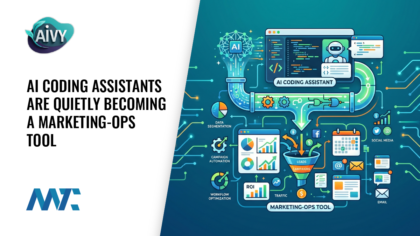
Most marketing teams already run on a thin layer of code that nobody calls code. A spreadsheet formula that reshapes an export, a Zapier step with a custom snippet wedged into it, a tracking parameter someone hand-edits before every campaign. The work was always there. What has changed is who can now write the bit in the middle without filing a ticket.
AI coding assistants are the reason. They have moved fast from a developer novelty to something a competent marketing-ops person can use on a Tuesday afternoon to solve a problem that would otherwise have waited two sprints for engineering. That is genuinely useful, and it is also where a fair amount of quiet risk has started to accumulate.
This piece is about the practical version of that shift: what marketers actually build, why the tool you pick behaves differently from the one your developer friend recommended, and where the sensible line sits between helping yourself and creating a mess someone else has to clean up.
What Marketers Realistically Build
Start with the honest inventory, because the marketing version of this is smaller and more useful than the demos suggest. Nobody on an ops team is shipping a customer-facing application. They are building the connective tissue between tools that do not cleanly talk to each other.
The common jobs look like this:
- A script that pulls last month’s spend from three ad platforms and writes one tidy sheet, so the Monday report stops taking an hour.
- A small transformation that takes a messy CRM export and reshapes it into the exact column order a list-upload tool demands.
- A bit of JavaScript that fixes a tracking gap on a landing page when the developer queue is three weeks deep.
- A scheduled job that watches a form endpoint and pings a Slack channel when a high-value lead arrives.
None of this is glamorous. All of it is the kind of work that used to sit in a backlog precisely because it was too small to prioritize and too fiddly to do by hand. An assistant that can write, explain, and correct twenty lines of code closes that gap for a person who understands the data but not the syntax. That is the real shift, and it is worth being specific about it rather than gesturing at AI for marketing.
Autocomplete is Not the Same as an Agent
Here, the choice of tool stops being cosmetic. There are two quite different things being sold under the same banner, and confusing them is the first mistake.
The first kind is an assistant that lives inside your editor and suggests the next line as you type. It is fast, forgiving, and does nothing you did not ask for, character by character. You stay in the driver’s seat. The cost is that you have to know roughly what you are doing, because the tool finishes your sentences rather than writing the paragraph.
The second kind is agentic. You describe an outcome in plain language, and it plans the steps, writes files, runs commands, reads the output, and corrects itself. This is the category that makes the marketing-ops use case feel achievable for a non-engineer, because you can ask in words and watch it work. It is also the category that can delete the wrong file or run a command against the wrong environment while you are reading Slack. The honest framing is that the two tools differ on exactly this axis of autonomy, and anyone evaluating them should read a side-by-side like Claude Code and Codex compared with their own risk tolerance in mind, rather than the benchmark scores.
For a marketer, the agentic kind is usually the one worth learning, because the whole point is not to need the syntax. But that power is exactly what the next section is about.
Guardrails for People Who are Not Engineers
The uncomfortable truth is that an agentic assistant will do confidently wrong things, and it will explain them persuasively while doing so. The skill you actually need is not coding. It is knowing what must never be touched without a second pair of hands.
A few rules hold up well in practice.
- Keep anything that runs against live customer data or production systems behind an engineer’s review. The assistant can draft it. A human who understands the blast radius should approve it before it runs.
- Work on copies. Export the data, run the script against the copy, and check the output by hand before anything writes back to the source of truth.
- Never paste real customer records, API keys, or access tokens into a prompt. Treat the prompt window as if it were a public channel, because the data leaving your laptop is the part you cannot recall.
- Read what it writes before you run it. You do not need to follow every line, but you should be able to say in one sentence what the script does and what it touches.
These are not exotic precautions. They are the same instincts a careful person already applies to a bulk email send, which is the closest thing most marketers have to a genuinely irreversible action. The assistant simply widens the range of irreversible actions you can now reach, so the instinct has to stretch to cover them.
Where This Actually Saves Time
The payback is real, but it is concentrated in a particular shape of task, and it helps to name that shape rather than promise blanket productivity.
It saves the most time on work that is repetitive, well-defined, and low stakes if it goes slightly wrong. The weekly data pull. The format conversion. The one-off scrape of a page you already have permission to read. These are jobs where the cost of a small error is a re-run, not a customer incident, and where the alternative was either an hour of manual tedium or a fortnight in someone else’s queue.
For an agency, the compounding effect is across clients. A reporting script written once and adapted for each account turns a recurring billable-but-boring chore into something close to free. For an in-house team, the win is independence from the engineering backlog for the small stuff, which also tends to improve the relationship with engineering, because the trivial requests stop landing on their desk.
What it does not do is replace judgment about what is worth building. The assistant will happily help you automate something that should not exist. Deciding that the Monday report matters, and that it should contain these five numbers and not fifteen, is still the human’s job and the part that carries the value.
Where to Still Call an Engineer
The line is clearer than the hype admits. Call an engineer when the thing you are building will run unattended on a schedule and touch production. Call one when it writes back to a system of record, when it handles customer data at any scale beyond a hand-checked sample, or when a failure would be silent rather than obvious. Call one when you find yourself copying the same fragile script into its fifth home, and it has quietly become infrastructure.
The useful mental model is that these tools have lowered the cost of the first ninety per cent of a small job, the part that used to be a barrier, while leaving the last ten per cent, namely the part about safety, scale, and consequences, exactly as expensive as it always was. A marketing team that internalizes that split gets most of the upside and very little of the trouble. The teams that get burned are the ones who mistook a fast, fluent first draft for a finished, production-ready system, and there is a meaningful difference between the two.