The AI-First Marketing Organization: What It Looks Like When Agents Handle the Work while Humans Handle the Wonder
For decades, marketing departments have been organized around a fundamental scarcity: human attention. We staffed teams to account for the fact that research, analysis, production, and optimization take time. Org charts grew sideways with specialists because no single person could absorb the workload. Coordinators emerged to coordinate the coordinators. Reporting cycles bent around the limits of how fast a human analyst could pull, clean, and interpret data.
Agentic AI dissolves that scarcity. And when the scarcity goes, so does the rationale for the structure built around it.
The optimal marketing organization with agentic AI fully implemented is not the current org chart with some prompts bolted on. It’s a fundamentally different shape, with fewer layers, different roles, and a radically different relationship between humans and the work itself. The humans who remain are not the ones doing the most tasks. They’re the ones doing the most thinking, the most judging, and most importantly, the most creating.
What the Optimal Structure Actually Looks Like
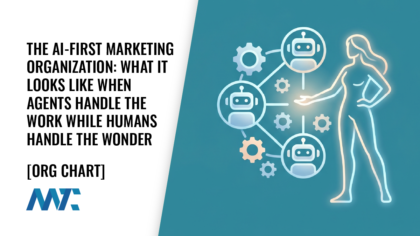
The AI-first marketing organization operates as a small core of strategists, creators, and orchestrators supported by a fleet of specialized agents that do the labor-intensive work continuously, in parallel, and without fatigue. The shape is closer to that of a film production company than a traditional marketing department: a tight creative leadership team that defines the vision, supported by an extensive on-demand crew that executes it.

At the center sits a Chief Marketing Officer (CMO) whose job has narrowed and deepened. Narrowed because operational reporting, campaign monitoring, and performance synthesis are handled by agents that produce executive-ready intelligence on demand. Deepened because the CMO now spends nearly all of their time on positioning, narrative, customer truth, and brand-defining decisions that agents cannot make.
Reporting to the CMO are three functional leads, not the traditional five to seven:
- A Head of Brand and Creative owns the voice, visual system, narrative arcs, and creative output that define how the company shows up in the world.
- A Head of Growth owns acquisition, monetization, and the experimental engine that finds new channels and tactics.
- A Head of Customer Experience (CX) owns the customer lifecycle, retention, advocacy, and post-purchase relationships.
DemandGen, content marketing, product marketing, field marketing, and the dozen other historical sub-functions collapse into these three because agents handle the cross-functional execution that previously required dedicated headcount for each silo.
Beneath those leads, the team is small and senior. Where a traditional 50-person marketing department might have 35 specialists and 15 managers, the AI-first equivalent might be 18 people total: a dozen senior creators and strategists, three or four agent orchestrators, and the leadership layer. The specialists who remain are deeply skilled at the things agents do poorly. The orchestrators are an entirely new role.
Surrounding this human core is the agent layer:
- Research agents that continuously monitor competitors, category trends, customer sentiment, and emerging cultural signals.
- Analysis agents that interrogate campaign performance, attribution, cohort behavior, and pipeline health on demand.
- Production agents that draft, format, version, localize, and deploy assets across channels.
- Optimization agents that run experiments, adjust bids, rotate creative, and tune sequences without waiting for a weekly meeting.
- Customer-facing agents that handle qualification, support, and lifecycle messaging at a scale and consistency no human team could match.
The agents don’t replace creativity. They replace the surrounding labor that historically prevented creativity from getting enough oxygen.
Why This Structure Wins
The argument for this shape rests on the observations about what agents are actually good at and what they’re actually bad at.
- Agents are extraordinary at the work that once filled calendars. Pulling data from seven systems and reconciling it. Reading 200 competitor pages and summarizing positioning shifts. Drafting 40 variants of an email subject line. Localizing a campaign into 14 markets. Monitoring brand mentions across the web in real time. Reformatting a long-form piece into 12 channel-appropriate derivatives. These tasks consumed an enormous share of traditional marketing capacity, and they were the ones that made marketers feel like operators rather than creators.
- Agents are mediocre to poor at the work that actually moves brands. Deciding what the company stands for. Recognizing the cultural moment a brand should step into or avoid. Sensing when a tactic that’s working should be abandoned because it’s eroding something more important. Writing the line that makes someone feel something they didn’t expect to feel. Choosing which customer truth to build the next year around. These judgments require taste, context, ethical weight, and a felt understanding of what it means to be human in a market, and they remain stubbornly human work.
The optimal structure aligns the org chart with this reality. It assigns the high-volume, high-complexity, low-judgment work to the agents that excel at it, and it concentrates human capacity on the low-volume, ambiguous, high-judgment work where humans still win. The result is not just faster output. It’s a better output because the humans are no longer exhausted by the operational tax that historically left them with two creative hours a week.
There’s a second benefit that compounds over time. When an organization shifts staffing from execution capacity to judgment, the talent profile changes. You’re not hiring people who can ship a lot of work. You’re hiring people who can decide which work should exist, and shape it once it does. That kind of talent is rarer, more expensive per person, and dramatically more valuable per dollar spent.
How Human Roles Must Adapt
Every role in marketing changes in this model, but the change is not uniform. Some roles consolidate. Some elevate. Some disappear. New ones appear that didn’t exist before.
The content marketer becomes a content director. The historical job was largely production: write the brief, write the piece, write the social pulls, write the follow-up. The new job is editorial judgment at scale. Agents draft the brief, draft the piece, draft the derivatives. The human decides what’s worth publishing, what voice it should carry, what point of view it should advance, and what gets killed. The skill shifts from writing fast to editing well, and from producing volume to defending quality against the temptation of infinite output.
The performance marketer becomes a growth strategist. The historical job was knob-turning: adjust bids, rotate creative, build audiences, monitor dashboards. Agents now do all of that continuously. The human’s job is to decide which experiments are worth running, which channels deserve investment before evidence, and which performance signals are actually meaningful rather than statistically noisy. The skill shifts from operating the machine to designing what the machine should try next.
The marketing analyst becomes a marketing scientist. The historical job was answering questions: pull this report, build this dashboard, segment this list. Agents answer those questions in seconds now. The new job is asking better questions. Identifying the second-order patterns that the agents missed. Designing the measurement frameworks that determine what the company even considers success. The skill shifts from data retrieval to research design and inferential thinking.
The campaign manager becomes an agent orchestrator. This is the role that genuinely didn’t exist before. Orchestrators design the workflows that connect agents to one another, data sources, brand guardrails, and human review points. They write the system prompts that define how agents represent the brand. They build the evaluation rubrics that determine whether the agent’s output is good enough to ship. They monitor for drift, hallucinations, and subtle failures that occur when systems run unattended. This role sits closer to a product manager than a traditional marketer, and it’s becoming one of the most valuable hires a marketing organization can make.
The creative director becomes more powerful, not less. When production constraints disappear, the bottleneck becomes the quality of the creative thinking itself. A creative director with agent leverage can develop, test, and refine more concepts in a week than a traditional team could in a quarter. The role becomes less about managing producers and more about generating the original ideas that everything else gets built around. The taste, the instinct, the ability to recognize a great idea before it’s polished, all of that becomes more valuable, not less.
The PR and communications lead absorbs a wider remit. Agents handle media monitoring, journalist research, draft outreach, and first-pass crisis detection. The human focuses on relationships, judgment calls about narrative, and the high-stakes moments when a brand has to choose what to say and what to leave unsaid. The role becomes more strategic and more senior, even as the team around it shrinks.
The roles that genuinely disappear are the coordinator, the project manager translating between specialists, and the junior specialist whose work was largely throughput. This is the hardest truth in the transition, and it deserves to be named clearly rather than buried in optimism. The work those roles did still needs to happen, but agents do it now. Organizations that pretend otherwise will carry costs their competitors don’t.
Unleashing Creativity When the Operational Tax Disappears
Most marketers became marketers because they wanted to make things. They wanted to tell stories, build brands, design experiences, write words that mattered. Then they spent their careers doing almost none of that, because the operational surface area of modern marketing devoured their calendars. Status meetings about status meetings. Reformatting decks. Cleaning data. Approving routing logic. Writing the same email for the fourteenth time with minor variations.
The most underappreciated benefit of agentic AI is not productivity. It’s the restoration of creative time to people who entered the field for creative reasons.
When agents absorb the operational tax, the human marketer’s week reshapes itself around entirely different work. Long blocks of uninterrupted thinking time become possible because the urgent operational interruptions have an automated owner. Cross-functional collaboration becomes generative rather than logistical because meetings can focus on ideas rather than coordination. Experimentation becomes faster because prototypes can be built in hours rather than sprints. Creative ambition rises because the cost of trying something has collapsed.
Teams in this configuration consistently report a strange phenomenon: they make more interesting work, not just more work. The campaigns get weirder, in a good way. The writing gets sharper because editors have time to actually edit. The visual systems get more cohesive because designers have time to think systemically rather than producing one-offs. The brand voice gets more distinctive because the people stewarding it have time to develop and defend a point of view.
This is the real prize. The productivity gains are real, but they’re a side effect. The main event is that marketing becomes an interesting place to work again, which means it becomes a place where interesting people want to be, which means output improves in a compounding way that pure efficiency could never produce.
There’s a discipline required to capture this benefit. Organizations that simply pocket the time savings as headcount reductions miss the upside entirely. The leadership commitment has to be explicit: time freed by agents gets reinvested in creative depth, not extracted as cost savings. The teams that win in this era will be those whose leaders treat unleashed human capacity as a strategic asset rather than a budget line item to optimize.
Digitally Transforming Your Marketing Department Into an AI-First Organization
The transition from a traditional marketing organization to an AI-first one is not a software implementation. It’s a redesign of how marketing work happens, who does it, and what success looks like. It runs on a timeline measured in quarters, not weeks, and it succeeds or fails on leadership clarity rather than technology choices. Here are the phases of digital transformation (DX):
- Honest assessment. Map the actual work your marketing team does in a typical month, not the work they were hired to do. Most leaders are surprised by how much of the actual time is consumed by operational tasks that agents could absorb: data pulls, status updates, reformatting, routing, monitoring, and first-draft production. Until this map exists, the redesign has nothing to redesign against. This phase typically takes four to six weeks and produces a candid inventory of where human time actually goes.
- Targeted agent deployment in the highest-tax areas. Resist the temptation to deploy agents everywhere at once. Pick the two or three workflows where the operational tax is highest, and the judgment requirement is lowest. Performance reporting, content repurposing, and competitive monitoring are common starting points because they’re high-volume, low-ambiguity, and easy to measure. Stand up agents in those workflows with explicit human review points and a clear evaluation rubric for what good output looks like. Run them in parallel with human execution for a defined period to compare quality honestly. This phase usually runs two to three months and produces both early wins and the organizational muscle for what comes next.
- Role redefinition. Once agents are demonstrably handling meaningful work, the human roles around them need to be redrawn rather than left to drift. This is the phase most organizations skip, and skipping it is why most AI initiatives plateau. Sit down with each team member and rewrite their role definition around what they will own now that agents handle the operational layer. Identify the skills they need to develop, the work they need to stop doing, and the new accountabilities they’re taking on. Be explicit about the orchestrator role and either hire for it or develop someone into it. This phase is uncomfortable because it forces honest conversations about what people are actually good at, but it’s where the structural transformation actually happens.
- Workflow redesign at the team level. With roles redrawn, the team’s operating rhythms need to change to match. Weekly status meetings get replaced by agent-generated briefings that humans read before meetings. Monthly performance reviews are replaced by continuous monitoring, with humans intervening for anomalies. Quarterly planning gets compressed because the research and synthesis that used to take weeks now takes hours. This phase reveals which legacy rituals existed because of information scarcity and quietly retires them.
- Governance and brand safety infrastructure. As more work runs through agents, the risks shift. Brand voice drift, factual hallucination, compliance gaps, and tone misfires become operational risks that need real systems. Establish a brand voice document detailed enough for agents to follow, an evaluation framework for agent-produced content, an escalation path for edge cases, and an audit cadence for spot-checking output. This is unglamorous work, and it’s the difference between an AI-first organization that scales and one that produces an embarrassing public failure that sets the whole program back.
- Creative reinvestment. With operational capacity freed, leadership has to explicitly direct that capacity toward creative ambition rather than letting it dissipate into more meetings. This means new creative initiatives that wouldn’t have been feasible before, deeper brand work, more experimentation, more original thinking. Without this phase, the transformation yields efficiency but not the creative renaissance that makes the whole thing worth doing.
Throughout all six phases, two leadership behaviors determine whether the transformation succeeds. The first is honesty about what’s changing, including the parts that are hard. Roles are shifting; some are disappearing; skill requirements are rising; and pretending otherwise breeds the cynicism that kills transformation efforts. The second is patience with depth over breadth. Organizations that try to deploy thirty agent workflows in a quarter produce thirty mediocre implementations. Organizations that deploy three well, then three more, then three more, build the institutional muscle that compounds.
The marketing organizations that will define the next decade are being built right now by leaders who recognize that the question is not whether agents will reshape the function. The question is whether their organization will be reshaped intentionally by them or reactively by competitors who move first. The optimal structure exists. The roles are knowable. The transformation is doable. What it requires is the willingness to redesign the org chart around the work as it is now, rather than how it used to be.
The team that does this will not be the largest. It will be the most creative, the most strategic, and the most consequential. And that, for marketers who got into this work to make things that matter, is finally a structure worth showing up for.


