Data Doesn’t Drive Growth. Better Decisions Do.
Data has become one of the most valuable assets in modern business.
Organizations invest heavily in analytics platforms, dashboards, reporting tools, and data infrastructure. Startups, in particular, often believe that more data will automatically lead to faster growth.
Yet many companies find themselves surrounded by metrics while struggling to achieve meaningful business outcomes.
The reason is simple:
Data does not drive growth.
Better decisions do.
The Myth of Data-Driven Growth
The phrase data-driven has become a business buzzword.
Companies collect data from:
- Marketing campaigns;
- Websites;
- Sales pipelines;
- Customer interactions;
- Product usage;
- Social media platforms.
As a result, leaders often assume that having more information will naturally improve performance.
Unfortunately, data alone has no value until it influences action.
A dashboard full of numbers does not create growth.
A report does not create growth.
A spreadsheet does not create growth.
Growth occurs when people use information to make better decisions.
Why More Data Is Not Always Better
Many organizations suffer from a problem that receives far less attention than data scarcity:
Data overload.
Every week, teams receive reports containing dozens of metrics.
Traffic increases.
Engagement fluctuates.
Conversion rates move slightly.
New leads enter the funnel.
However, leaders often struggle to answer a fundamental question: “What should we do next?”
When data lacks context, it creates noise instead of clarity.
The challenge is no longer access to information.
The challenge is interpretation and prioritization.
The Real Competitive Advantage
Businesses rarely gain an advantage simply because they have data.
Most companies today have access to similar analytics tools.
The real advantage comes from the ability to transform information into insight and insight into action.
Successful organizations develop a decision-making process that connects:

Without this sequence, analytics become an expensive reporting exercise.
The Role of Clarity
One of the most overlooked business capabilities is clarity.
Clarity allows leaders to:
- Identify what matters most;
- Ignore distractions;
- Prioritize initiatives;
- Allocate resources effectively;
- Act with confidence.
Organizations often believe they need more information when what they actually need is greater clarity.
The goal should not be to monitor everything.
The goal should be to understand what deserves attention.
Growth Is a Decision-Making Process
Every growth outcome can be traced back to a series of decisions.
Examples include:
- Which customer segments to target;
- Which acquisition channels to prioritize;
- Which products to improve;
- Which opportunities to pursue;
- Which initiatives to stop.
These decisions influence:
- Revenue growth;
- Customer acquisition;
- Retention;
- Profitability;
- Long-term sustainability.
Data supports these decisions.
It does not replace them.
Questions Leaders Should Ask
Instead of asking:
What data should we collect?
Leaders should ask:
What decisions are we trying to make?
This shift changes the role of analytics entirely.
The focus moves from collecting information to supporting outcomes.
Useful questions include:
- What is preventing growth?
- Where are we losing customers?
- Which channels generate the highest-quality opportunities?
- Which initiatives deserve additional investment?
- What should we stop doing?
When analytics help answer these questions, they become valuable.
Building a Decision-Oriented Culture
Organizations that grow consistently tend to share a common characteristic:
They use data as a decision-support system rather than a reporting system.

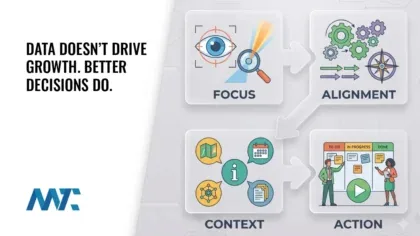
This requires:
Focus
Track the metrics that matter most.
Alignment
Ensure teams understand the same business objectives.
Context
Interpret numbers within the reality of the business.
Action
Turn insights into decisions and decisions into execution.
Without action, data remains inactive.
Final Thoughts
Data is essential.
But data alone does not create growth.
Growth emerges from the quality of the decisions organizations make every day.
The companies that outperform competitors are not necessarily those with the most data.
They are the ones that create the most clarity from the data they already have.
Because in the end, growth is not a data problem.
It is a decision-making problem.
And better decisions are what truly drive growth.