Why Digital Transformation Fails Without Operational Organization
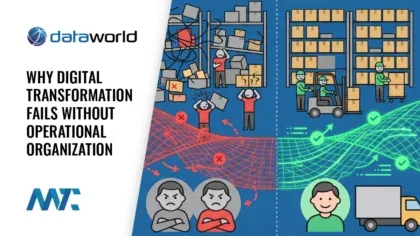
It doesn’t take long to ask what digital transformation (DX) means to most modern companies. Cloud platforms, automation tools, AI, and analytic dashboards that promise to convert huge amounts of data into insightful decisions. Sounds impressive? Indeed, there’s one more aspect of digital transformation that is often overlooked, even though it lies at the foundation of all the above: none of that software can operate efficiently in a physically disorganized business.
Even if the company invests in the best available inventory software on the market, it will hardly be helpful in the case of disorganized operations where inventory is scattered on unlabeled shelves or stacked in a corner, as there is simply no more room to keep it. In that case, software would generate only detailed reports on disorganization.
Software Deals With Information, Not the Physical Aspects of Business
The mistake many businesses make regarding digital transformation is that they assume technology allows them to organize and process information extremely fast and effectively, but it fails to address the physical processes that lie beneath. Warehouse management software will tell the company how much inventory it should have, but it won’t do anything to organize it logically, let alone ensure the safety of the inventory.
The issue mentioned above is crucial as it is often ignored during digital transformation processes. A business can invest heavily in automation but end up watching its inventory fulfillment slow down simply because the underlying software environment hasn’t caught up yet. The system knows where inventory is supposed to be, while the floor doesn’t. As a result, the digital tool that relies on this data generates decisions based on false assumptions.
The above information is not a criticism of technology. It simply demonstrates that technology can magnify the environment in which it is applied. The well-organized, logically structured, and properly shelved physical workspace becomes a key to success for every digital infrastructure applied to it. In the case of disorganized operations, the picture is the opposite despite software quality.
Why Organized Workspaces Can Be Productive Multipliers
The reason the problem mentioned above persists in some cases, despite the company’s interest in technology, lies in a relatively simple mechanism that needs to be explained.
When a workspace is organized, well-structured, and logically shelved, the workflow built on it becomes faster and more accurate. Employees spend less time finding things, stock counts correspond to reality, thus reducing the number of mistakes made by the automated ordering system. Equipment is returned to its rightful place, saving time for other employees who need it.
None of the above leads to a dramatic failure of technology; rather, it causes low-level friction that digital tools cannot detect and therefore can’t fix. The software has no way of knowing that the cause of inefficiency is not the algorithm but the fact that picking staff need to go the long way around a storeroom simply because it was not reorganized after the company doubled in size.
The above situation is precisely what enables organized physical infrastructure to become a true productivity multiplier, rather than a background detail. Despite the quality of the digital systems, a business can be undermined by disorganized physical workspaces. Businesses that invest in practical storage solutions such as garage storage shelving create more efficient workshops, storerooms, and commercial areas for easier SKU organization and equipment storage. It is a simple solution, but it enables improved performance across the entire business.
The Relation Between Inventory Visibility and Efficiency
Visibility of the inventory and efficiency of the fulfillment process are closely related, but in many cases, the physical side of things disrupts this relationship.
If the inventory is stored in a logical, consistent way, divided into zones and categories, picking and packing will be considerably faster, and this holds true for both sophisticated digital systems and simple spreadsheets. The reverse is also true: no software can fix the situation when the inventory is stored across three different shelves without any logic between them.
And that is where employee efficiency is reduced. In the disorganized workspace, workers spend part of their time moving through it, walking extra distances, double-checking locations, and correcting mistakes caused by poor labeling. None of these efforts are detected by the productivity dashboard as wasted time spent searching for things. All of that results in somewhat lower company productivity, and it is difficult to detect until someone moves around the floor and notices the problem.
Interdependence Between Digital Tools and Physical Systems
The companies that benefit from digital transformation often approach the digital and physical aspects of their business as connected processes, not as separate projects with separate budgets. A well-organized storeroom, used in combination with a warehouse management system, can help the company achieve real improvements. But in the case of a chaotic storeroom, the same software will only generate reports on the chaos.
It is easy to overlook this aspect when digital transformation is treated as a technological implementation project. The software is only as good as the physical environment supporting it. To organize the latter, a company should pay special attention to organized shelving, consistent inventory zones, and logical equipment storage. With it, digital tools will provide the company with all the benefits they were supposed to bring.
Conclusion
Digital transformation is not about choosing software for the company. It is about organizing the operation to use the software as efficiently as possible. All the companies that have successfully implemented automation, analytics, and AI have one important thing in common: their physical workspace was organized before, or at least in parallel with, the technological implementation.
It is worth thinking over before making the next big investment in technological solutions. The system purchased will only be as good as the environment it operates in. If the environment hasn’t been paid proper attention lately, that is the place to start.