From Content to Contracts: How Small Businesses Are Turning AI Into Real ROI
I just flew back from Adobe Summit, and I can honestly say there wasn’t a single conversation, keynote, or breakout session that didn’t center on how AI is reshaping the work. Whether the topic was creative production, customer journeys, commerce, or document workflows, every thread eventually pointed to the same question: what does this look like when AI is doing the heavy lifting? The energy in Las Vegas made one thing clear. AI is no longer the future of marketing and operations. It’s the present, and the companies pulling ahead are the ones actually putting it to work.
That context made Adobe’s new small business study especially timely. Adobe surveyed 431 small business owners to understand where generative AI is delivering measurable time savings, revenue growth, and confidence. The findings echo what I heard on the ground at Summit. Small teams are no longer debating whether to adopt AI. They’re deciding how to get more out of it. Content creation and document intelligence are emerging as the two biggest levers, and the financial impact is showing up in both hours saved and revenue earned.
Here’s a walk-through of the data Adobe shared, with the study’s own visuals along the way.
How Small Businesses Are Using AI Today
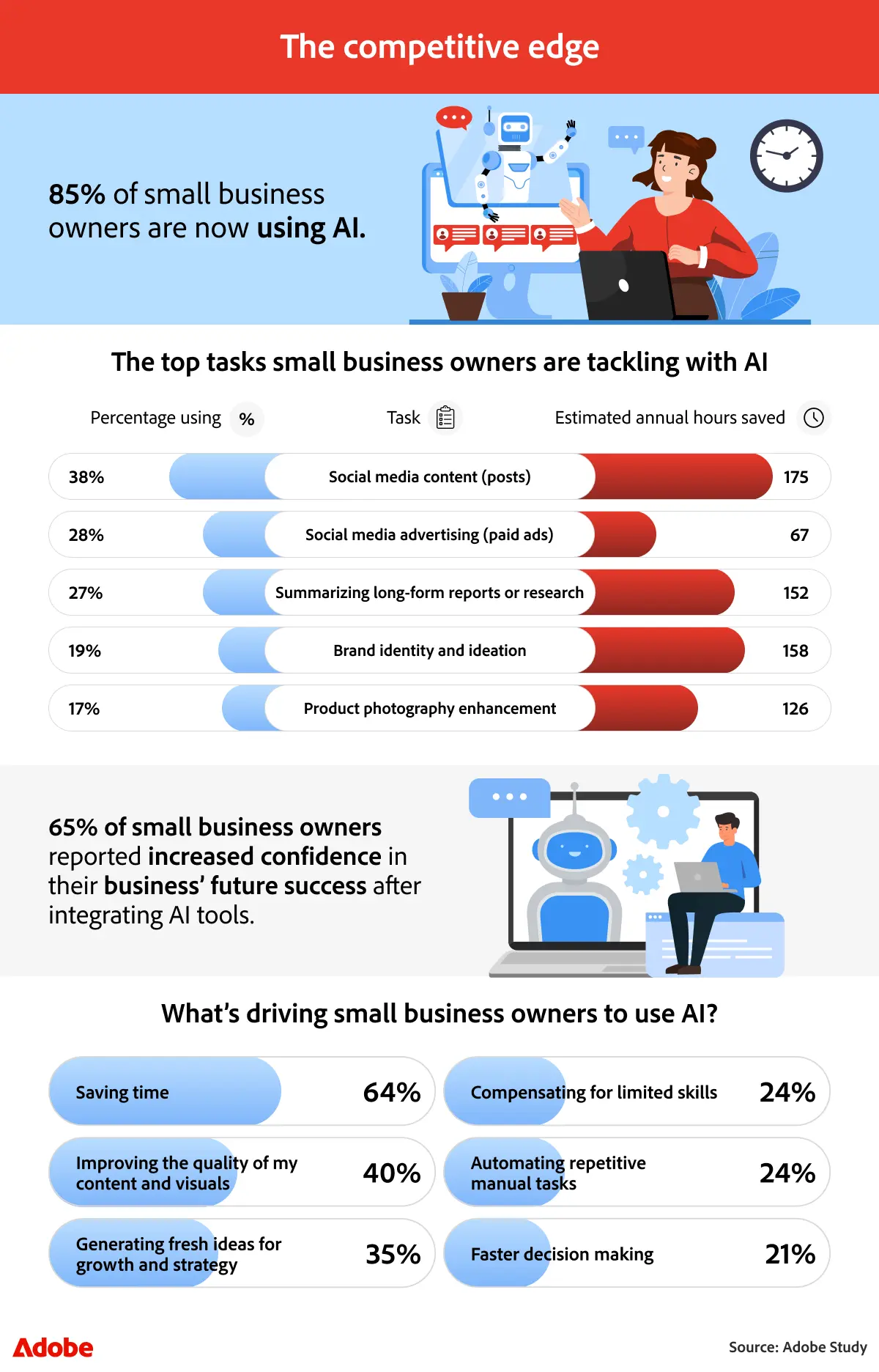
Eighty-five percent of small business owners surveyed are now using generative AI (GenAI), and 65% say it has made them more confident about their company’s future. The tool mix leans heavily toward text generation at 77%, followed by image generation at 30%, data analysis at 29%, document intelligence and AI assistants at 18%, and code or website builders at 11%.
Social media content is the leading AI-driven task, cited by 38% of respondents, saving an average of 175 hours and an estimated $5,816 per year. Using AI to summarize reports saves another 152 hours and roughly $5,051 annually. Time savings are the top motivator at 64%, but the dollars behind those hours are what make the case stick.
How AI Is Changing the Small Business Workday
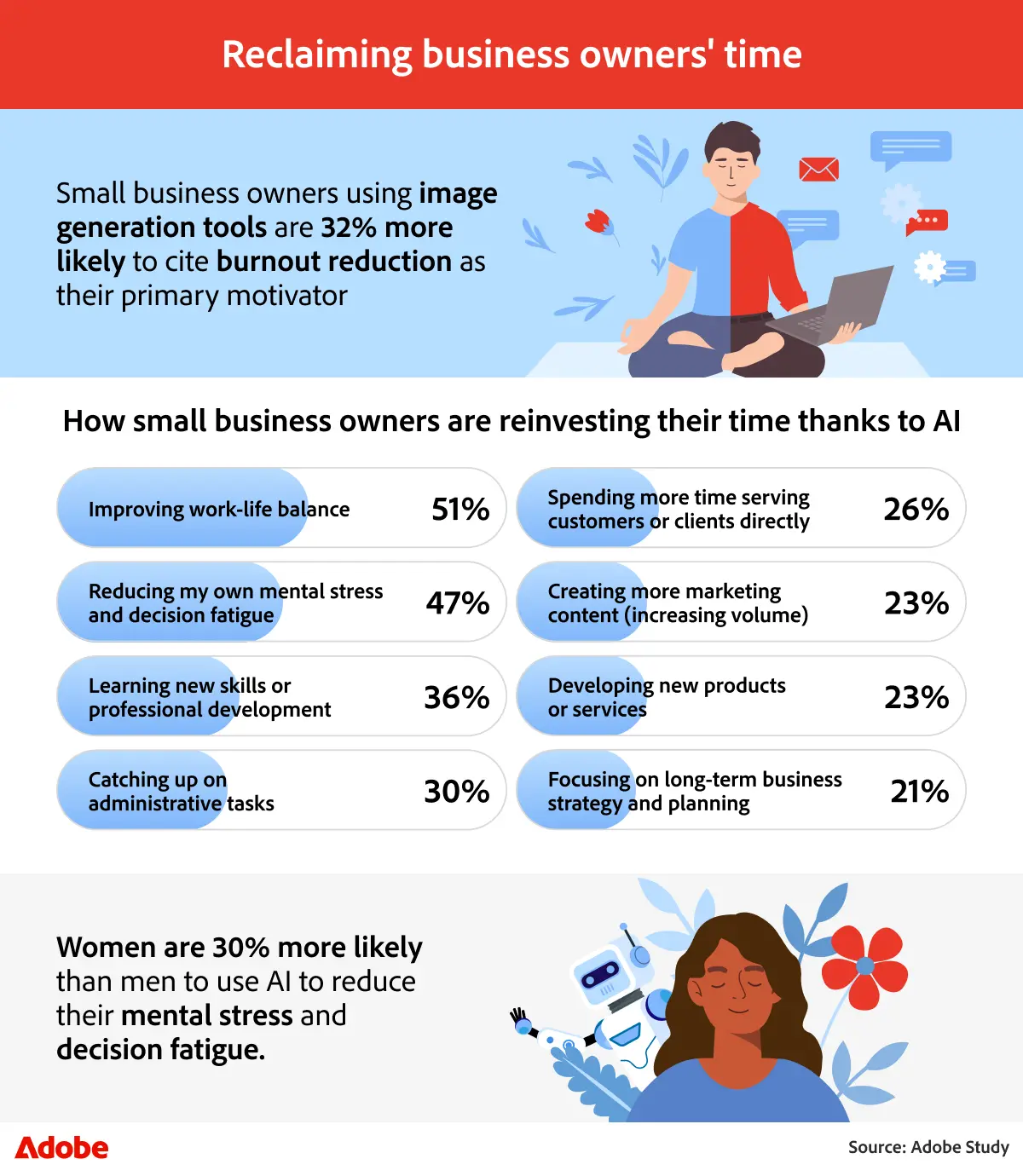
The reclaimed time is showing up in places that don’t always appear on a P&L. Fifty-one percent of small business owners surveyed use the hours saved to improve work-life balance, and 47% use them to reduce mental stress and decision fatigue. The type of tool shapes the payoff.
Owners using document intelligence are 110% as likely to cite automation as a top motivator, and those using AI image generation are 32% more likely to say reducing burnout is a key driver. Women surveyed are 30% more likely than men to cite mental stress reduction as a reason for adopting AI. This is the quieter half of the ROI story, and it matters for retention, focus, and creative output.
The Engagement and Revenue Impact of AI-Generated Content
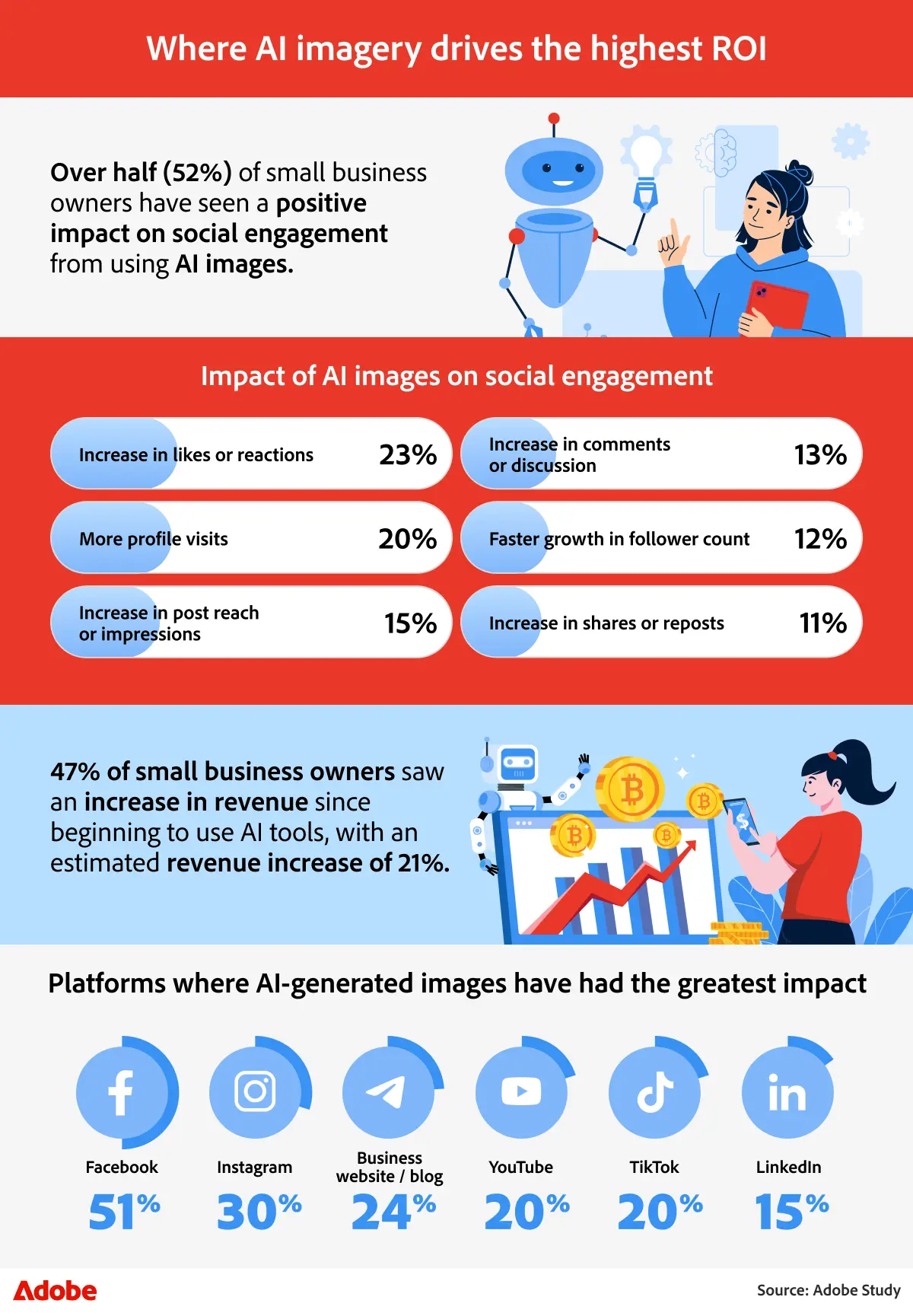
More than half of small business owners surveyed (52%) report a positive lift in social engagement after using AI-generated images. The biggest gains are increased likes and reactions at 23%, profile visits at 20%, and post reach and impressions at 15%. That engagement is converting. Forty-seven percent of respondents report a revenue increase since adopting AI tools, with an average lift of 21%.
Facebook leads platform impact at 51%, followed by Instagram at 30%, and owned websites or blogs at 24%. Tech business owners are 56% more likely than those in general business or management roles to see gains in likes and reactions, and 10% more likely than retail owners to report revenue growth. The pattern is consistent. Better visuals produced faster lead to more engagement, which compounds into revenue.
Building Confidence in AI
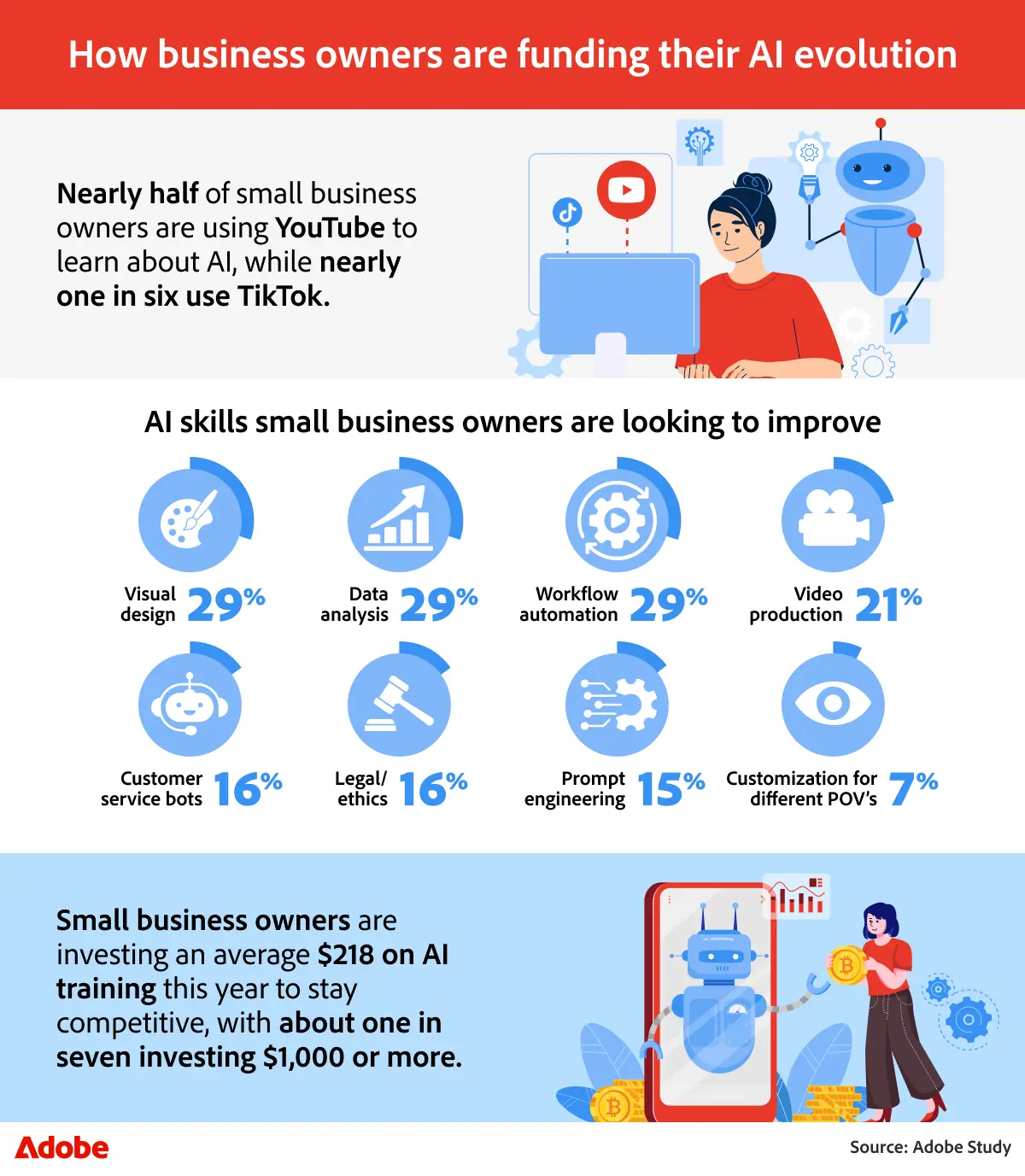
Adoption is wide, but the skill ceiling is still rising. Visual design, data analysis, and workflow automation tie as the top skills small business owners want to improve, each at 29%, followed by video production at 21%. Owners are investing an average of $218 in AI training this year, and roughly one in seven are committing $1,000 or more. Learning channels are split by generation and gender. Forty-six percent learn through trial and error, another 46% through YouTube, and 39% through online forums. Men surveyed are 44% more likely to use YouTube, while women are 58% more likely to turn to TikTok. Nearly a third of Gen Z owners are learning about AI on TikTok.
The hesitations are worth noting. Forty-two percent of respondents say AI output feels generic or lacks a human touch, 35% cite ethical concerns, 31% flag inconsistent quality, and 30% point to data privacy and security. These aren’t reasons to walk away. They’re reasons to invest in better tools, better prompts, and better workflows. The confidence loop is real: owners who feel more confident about their company’s future because of AI are investing 193% more in training than those who don’t.
Key Takeaways
Adoption has crossed the tipping point. With 85% of small business owners using generative AI and 47% already seeing revenue growth averaging 21%, this is no longer early-adopter territory. It’s table stakes.
- The fastest wins are in content and documents. Social media content creation saves an average of 175 hours per year. Summarizing reports saves another 152 hours. Tools like Adobe Firefly for visuals and Adobe Acrobat’s AI Assistant for document intelligence cover both sides of that equation.
- AI-generated visuals are driving measurable social performance. More than half of owners report engagement gains, with likes, profile visits, and reach leading the lift, and Facebook showing the strongest platform impact.
- The human ROI is as real as the financial ROI. Half of owners are using their recovered time to improve work-life balance, and nearly as many use it to reduce stress and decision fatigue.
- Confidence fuels investment, and investment fuels confidence. Owners who feel more confident in their company’s future because of AI are putting nearly three times more money into training, which is exactly the flywheel small teams need to stay competitive.
If Adobe Summit was any indication, the gap between businesses using AI casually and those using it strategically is going to widen quickly. This study makes the case that small businesses can be on the winning side of that gap, starting with the two workflows where AI pays back fastest: the content they publish and the documents they process.