Demystifying ‘Loop Engineering’: The Marketer’s Guide to Self-Optimizing AI Prompts
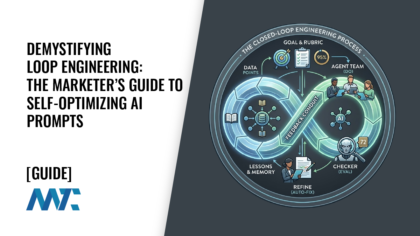
If you have been in the technology world for more than a minute, the current industry fixation on Loop Engineering probably triggers a profound sense of déjà vu. For anyone who cut their teeth writing lines of FOR...NEXT or WHILE loops in BASIC on a TRS-80 (that’s how old I am), the core concept sounds less like a revolution and more like computing fundamentals 101. A loop is a loop: you execute an instruction, check a condition, and repeat until that condition is satisfied.
So why is the AI industry acting like it just invented fire?
Because we are shifting from looping deterministic code to looping probabilistic models. In traditional programming, loops process explicit parameters. In Loop Engineering, we are embedding generative models within autonomous architectures that enable them to critique, edit, and perfect their own creative output without human intervention.
For marketing professionals, this represents a massive operational leap. Instead of endlessly tweaking a prompt to get a better email draft or blog post—essentially acting as the manual loop mechanism yourself—you build an automated structure where the AI acts as the strategist, the writer, the critic, and the editor. It doesn’t stop running until it meets a pre-defined quality score. It shifts your role from a prompt engineer to a creative systems architect.
The Hidden Threat: Token Burn
Before launching multi-stage loops, you must understand the financial operational catch: probabilistic loops burn through tokens at an exponential rate. Unlike standard execution, where a prompt yields a single direct output, an automated loop might write, critique, rewrite, and reject an asset five, ten, or twenty times before crossing your target quality line.
If you deploy a multi-agent system (e.g., separate Strategist, Writer, and QA Specialist agents) over a 15-pass iteration, each step passes increasingly heavy historical contexts back and forth. A single article draft that would normally cost $0.05 can easily balloon to $5.00 or $10.00 in API fees. If misconfigured without an explicit escape sequence, an infinite loop will happily drain your corporate budget while you sleep. Loop engineering is an incredibly powerful tool, but it requires strict guardrails.
The Master 7-Part Loop Checklist for Marketers
To move beyond standard prompting and build self-improving systems, apply this optimized 7-part architecture, explicitly designed to manage quality and control costs.
- Establish Your Baseline Brand Architecture: Define global corporate constraints. Load voice, tone, and forbidden vocabulary once so they are naturally injected into every downstream execution loop.
- Define an Explicit Objective & Quantitative Rubric: Never tell an AI to simply make it better. Give it a strict numerical scoring grid and an unyielding termination threshold (e.g., “Must score 95/100”).
- Deploy a Functional, Multi-Agent Team: Break monolithic prompts into a sequence of specialized functional roles—such as an SEO Analyst, a Copywriter, and a Formatting Editor.
- Isolate the Evaluation (The QA Checker): Never allow the agent that wrote the content to grade its own output. Use an unbiased, strict secondary evaluation agent to score against the rubric.
- Implement Token Guardrails & Circuit Breakers: Always engineer an automated escape hatch. Define a hard ceiling on maximum allowable iterations to prevent financial token hemorrhaging.
- Capture Continuous Memory and Vector Adjustments: Instruct the system to convert every stylistic failure or correction into a dynamic rule, saved to a localized reference log, that modifies future runs.
- Asynchronous Cloud Scheduling: Schedule the fully optimized execution framework to run server-side via cron-jobs or workflow orchestration tools, populating your dashboards with finalized drafts by morning.
The Loop Engineering Best Practice Guide
Best Practice 1: Modular Prompt Design
Do not build one massive prompt that attempts to handle the loop, the writing, and the evaluation at once. Break your loops down into separate, crisp text strings or distinct agent profiles. This minimizes context bloat and ensures cleaner execution.
Best Practice 2: Extreme Rubric Clarity
If your evaluation rubric uses vague terminology like make it engaging, your loop will spin endlessly or return inconsistent scores. Use binary or highly objective criteria in your scoring tables (e.g., Contains a specific case study metric = 20 points; lacks a metric = 0 points).
Best Practice 3: Linear Cost Mitigation
To avoid burning tokens on full-text rewrites, structure your feedback loops to fix only specific flaws identified by the evaluator rather than regenerating the entire document from scratch.
Marketing & Sales Execution Frameworks
Example 1: The High-Converting Enterprise B2B Sales Sequence Loop
This loop constructs an outbound cold sequence tailored to a specific target account list, checking it against strict compliance, personalization, and brevity guidelines before exporting.
# PHASE 1: INITIALIZATION & BRAND PROFILE
/init Setup loop profile for [Company] Enterprise Outbound.
Load rules to memory: Tone is consultative, direct, confident.
Banned words: "delighted", "tapestry", "hope this finds you well", "synergy", "revolutionize".
Language: US English.

# PHASE 2: GOAL & QUANTITATIVE RUBRIC
/goal Generate a 3-touch email cadence targeting Fortune 500 Chief Information Officers (CIOs).
Evaluate using the following 100-point rubric:
- Under 150 words per email: 30 pts
- Clear, single-sentence clear call-to-action (CTA): 25 pts
- Explicitly states one specific pain point relative to cloud spend: 25 pts
- Zero corporate buzzwords or filler phrases: 20 pts
Termination condition: Loop must terminate ONLY when draft achieves >= 95/100.

# PHASE 3: AGENT TEAM ASSIGNMENT
/agents Deploy team:
- Agent_1 (Sales_Strategist): Analyzes raw target data and isolates relevant hooks.
- Agent_2 (Copywriter): Crafts the raw sequence copy using the Strategist's hooks.

# PHASE 4: OBJECTIVE EVALUATION & QA
/agents Deploy Agent_3 (QA_Auditor). Agent_3 will independently read Agent_2's drafts and grade them against the Phase 2 rubric. If the score is below 95, Agent_3 must output a specific bulleted list of failures and pass the draft back to Agent_2.

# PHASE 5: CIRCUIT BREAKER GUARDRAIL
/guardrail Set Max_Iterations = 5. If the sequence does not hit a score of 95 within 5 full loop iterations, stop execution, flag the current highest-scoring draft, log the error, and export for manual review to prevent token overspend.

# PHASE 6: SYSTEM MEMORY LOGGING
/memory Save every rejected structural element into 'lessons_learned.txt'. Read this file at the start of every iteration step to prevent repeating stylistic errors.

# PHASE 7: SCHEDULING
/schedule Run this pipeline every Tuesday at 6:00 AM EST using the weekly updated target CSV file. Deliver final sequences to the sales enablement draft folder.
Example 2: The Programmatic SEO Content & Optimization Loop
This system acts as an autonomous digital content newsroom—scanning search intent, writing comprehensive long-form technical content, auditing keywords, and rewriting until it is fully search-optimized.
# PHASE 1: INITIALIZATION & BRAND PROFILE
/init Load Brand Voice: authoritative, clear, data-heavy, developer-centric.
Format rules: Markdown headers required, no em-dashes, short concise paragraphs, bulleted technical lists preferred.

# PHASE 2: GOAL & QUANTITATIVE RUBRIC
/goal Produce an in-depth article targeting the keyword "Automating Kubernetes Cost Optimization".
Evaluate using the following 100-point rubric:
- Primary keyword present in H1, introduction, and at least two H2s: 30 pts
- Includes at least three real-world open-source tooling examples: 30 pts
- Readability score matches Flesch-Kincaid Grade level 10 or lower: 20 pts
- Secondary keywords integrated naturally (minimum 4): 20 pts
Termination condition: Loop execution ends when draft scores >= 98/100.

# PHASE 3: AGENT TEAM ASSIGNMENT
/agents Deploy team:
- Agent_1 (SEO_Analyst): Extracts intent data and maps keyword distribution placements.
- Agent_2 (Technical_Writer): Drafts the deep-dive technical content incorporating structural parameters.

# PHASE 4: OBJECTIVE EVALUATION & QA
/agents Deploy Agent_3 (SEO_Auditor). Agent_3 acts as an unbiased algorithmic checker. Scans Agent_2's output against the programmatic rubric. If score < 98, generate an explicit, structural instruction set showing exactly where keywords or examples are missing and trigger a re-run.

# PHASE 5: CIRCUIT BREAKER GUARDRAIL
/guardrail Set Max_Iterations = 4. If execution exceeds 4 iterations without achieving a 98 score, halt execution entirely to conserve API token expenditure. Output the highest available version with a warning header: "[VOLATILE DRAFT - CEILING BREACHED]".

# PHASE 6: SYSTEM MEMORY LOGGING
/memory Track stylistic patterns that frequently trigger QA failures. Automatically save these constraints into the core execution rule block to accelerate downstream iteration steps.

# PHASE 7: SCHEDULING
/schedule Process the keyword target queue asynchronously on the 1st of every calendar month at 1:00 AM UTC. Automatically deposit approved drafts straight into the CMS review pipeline.
Shifting from Prompting to Architecture
Loop engineering isn’t a magical new AI capability; it is a fundamental software design principle applied to probabilistic systems. By automating the critique and revision steps that humans used to perform manually, marketing professionals can step away from the tedious, trial-and-error cycle of prompting and step into the role of a creative systems architect.
However, moving from single-turn prompts to autonomous loops requires a shift in mindset regarding risk and budget management. Without strict token guardrails and objective evaluation criteria, an unmonitored loop can quickly become an expensive operational liability. By building with modularity, establishing explicit scoring rubrics, and always enforcing a circuit breaker, you can securely scale your marketing, research, and data execution.
The goal is simple: Write your standards once, set up your evaluation guardrails, and let the loop perfect the execution while you sleep. Close the loop, step back, and let the system run.


