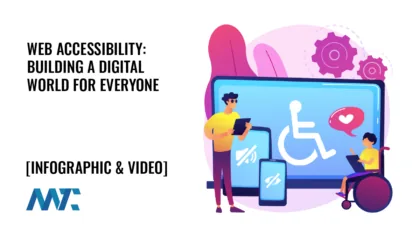
The practice of making digital tools and websites usable by all people, regardless of disability or limitations, is called accessibility. The term is often abbreviated as the numeronym a11y, where the number 11 refers to the number of letters omitted. This abbreviation follows the pattern of other numeronyms, such as i18n for internationalization and l10n for localization. The term is also listed on the USPTO Supplemental Register under Accessibility Now, Inc.
Core Principles: POUR
The World Wide Web Consortium (W3C) organizes accessibility standards under the Web Content Accessibility Guidelines (WCAG), which are built upon four foundational principles known as POUR:
- Perceivable: Information and user interface components must be presentable to users in ways they can perceive (e.g., providing text alternatives for images or captions for video).
- Operable: User interface components and navigation must be operable. The interface cannot require interaction that a user cannot perform (e.g., ensuring all functionality is available via a keyboard).
- Understandable: Information and the user interface's operation must be understandable. Users must be able to understand the information and the interface's operation (e.g., making text readable and predictable).
- Robust: Content must be robust enough to be interpreted reliably by a wide variety of user agents, including assistive technologies such as screen readers.
Assistive Technologies (AT)
Assistive technologies are specialized hardware or software that help individuals with disabilities interact with digital content. Common examples include:
- Screen Readers: Software (like NVDA, JAWS, or VoiceOver) that converts text and behind-the-scenes code into speech or Braille.
- Switch Access: Devices that allow users with limited mobility to control a computer using a single button or puff-and-sip mechanism.
- Screen Magnifiers: Tools that enlarge sections of the screen for users with low vision.
Technical Implementation: ARIA
WAI-ARIA (Web Accessibility Initiative – Accessible Rich Internet Applications) is a technical specification that provides a framework for adding attributes to HTML elements. These attributes don't change the visual appearance of a site but provide critical metadata to assistive technologies about the role, state, and property of dynamic content (e.g., identifying a group of divs as a tab panel or a modal dialog).
Modern AI Integration
Artificial Intelligence has transitioned from a theoretical tool to a primary driver of a11y efficiency:
- Computer Vision: AI models automatically generate descriptive Alt-Text for images that lack manual descriptions.
- Natural Language Processing (NLP): Real-time transcription and translation services provide immediate access to audio and video content for the deaf and hard-of-hearing.
- UI Remediation: Modern Overlays and testing suites use AI to identify and suggest fixes for common coding errors, such as missing labels or poor color contrast, in real-time.