Remote Work: What We’ve Actually Learned About Leadership, Productivity, and People
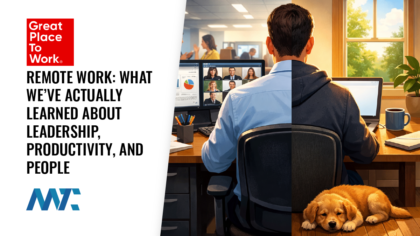
The conversation about remote work has become strangely binary. It is framed either as a triumph of modern flexibility or as a slow erosion of productivity, culture, and accountability. That framing is not just tired; it is misleading. After several years of lived experience, the more honest conclusion is that remote work works exceptionally well under the right conditions, fails predictably under the wrong ones, and exposes weaknesses that were often hidden inside traditional offices.
Many organizations, especially those that went fully distributed or heavily hybrid during the pandemic, now have enough data and scar tissue to move past ideology. What has emerged is not a verdict on location, but a clearer understanding of leadership behavior, job design, and employee readiness. Remote work did not invent these factors. It simply removed the walls that had masked them.
Remote Work Did Not Create Productivity Gaps; It Revealed Them
One of the most uncomfortable lessons of work from home is that not everyone thrives without structure. That reality existed long before Zoom calls and Slack channels. Offices provided external scaffolding: visual supervision, social pressure, fixed schedules, and constant interruption that could be mistaken for momentum. When those cues disappeared, individual work habits became visible.
Research reinforces this observation. Studies published by Great Place To Work show that remote productivity remains strong overall, but varies dramatically based on trust, cooperation, and leadership quality. Their analysis of more than a million employee responses found that people who feel they can rely on colleagues to cooperate are over eight times more likely to give discretionary effort. That finding alone dismantles the argument that proximity equals performance.
At the same time, Gallup’s ongoing workplace research paints a more nuanced picture. Fully remote employees report the highest engagement, but also elevated stress and loneliness. Engagement and well-being are not interchangeable. Autonomy can fuel output while quietly taxing mental health. Remote work did not create that paradox, but it amplified it.
Leadership Matters More When You Cannot See The Work
If there is a single non-negotiable requirement for successful remote work, it is competent, present leadership. Distributed teams do not fail because people are at home. They fail when leaders confuse visibility with clarity or activity with progress.
Strong remote leaders behave differently. They check in without hovering. They set expectations in writing, revisit priorities frequently, and remove obstacles before frustration hardens into disengagement. They measure outcomes instead of hours. Perhaps most importantly, they communicate even when there is nothing polished to announce.
1eatedly show that leadership quality is the dominant factor separating productive remote teams from struggling ones. During the most volatile months of the pandemic, employee comments shifted away from perks and toward phrases like incredible leadership and leadership understands. When productivity dipped later that year, unproductive employees overwhelmingly called for better leaders, not better tools or tighter policies.
This aligns with Gallup’s findings on trust. Leaders who are inconsistent, opaque, or performative create anxiety that spreads faster in remote environments. Without hallway conversations to soften confusion, ambiguity becomes corrosive. In contrast, leaders who are visible through consistent communication and accountability create psychological safety that sustains performance at a distance.
Some Jobs Are Naturally Remote-Friendly, Others Are Not
Another lesson worth stating plainly is that remote work is not universally applicable. This is not a failure of imagination; it is a function of the work itself. Jobs that require physical presence, specialized equipment, real-time coordination, or in-person care cannot simply be abstracted into digital workflows.
Even within knowledge work, suitability varies. Roles with clear deliverables, asynchronous execution, and measurable outcomes adapt far more easily than roles dependent on constant collaboration or ambiguous outputs. Software development, writing, design, data analysis, and many marketing functions often translate well. Specific managerial roles, onboarding-heavy positions, or highly reactive support functions may require hybrid models to avoid burnout or isolation.
The mistake many organizations made was assuming that location alone would determine success. In reality, job design matters more than job title. Teams that deliberately redesigned workflows for asynchronous execution outperformed those that simply moved meetings online and hoped for the best.
Maturity And Self-Management Are Not Evenly Distributed
Remote work places a premium on personal accountability. Without physical cues, individuals must regulate their own focus, energy, and motivation. That skill is not evenly distributed across age groups, experience levels, or personalities.
This is not a criticism; it is a developmental reality. Many people build their professional discipline over time. Early-career employees often benefit from the ambient learning of an office, where context, modeling, and informal feedback accelerate growth. More experienced professionals frequently report the opposite: fewer interruptions, deeper focus, and greater pride in their output when working remotely.
The lesson for organizations is not to exclude entire demographics, but to recognize that remote work readiness is a skill, not a perk. Training in time management, written communication, prioritization, and self-direction is as critical as technical onboarding. Companies that invested in these capabilities retained more talent and saw stronger long-term performance.
Culture Travels Through Behavior, Not Buildings
One of the more persistent myths about remote work is that culture dissolves without physical space. In practice, culture was never in the office furniture. It lived in how decisions were made, how conflict was handled, and whether people felt respected as whole human beings.
High-trust organizations proved this repeatedly. Nearly all companies on the Fortune 100 Best Companies to Work For list support remote or hybrid work, and their productivity significantly outpaces typical U.S. workplaces. These organizations did not preserve culture by mandating presence. They preserved it through cooperation, recognition, and consistent values.
Companies such as Salesforce, Atlassian, and Intuit illustrate this principle in different ways. Whether through open forums, location-agnostic policies, or explicit well-being investments, each demonstrates that culture scales when it is designed intentionally rather than assumed.
The Intersection That Makes Remote Work Succeed
After several years of experimentation, the conclusion is not that remote work is good or bad. Remote work succeeds at the intersection of three factors.
- First, the right leaders. These are leaders who prioritize trust over control, clarity over activity, and outcomes over optics. They understand that accountability does not require surveillance and that communication is a responsibility, not a broadcast.
- Second, the right jobs. Roles must be designed for asynchronous execution, clear ownership, and measurable results. When work is ambiguous, remote environments magnify confusion. When work is well-defined, distance often becomes an advantage.
- Third, the right employees. Remote work favors individuals who can self-regulate, communicate proactively, and take pride in their deliverables. These traits can be developed, but they must be acknowledged and supported, not assumed.
When those three elements align, location becomes irrelevant. Work becomes something people look forward to rather than endure. Productivity becomes sustainable rather than performative. And organizations stop arguing about where work happens and start focusing on how well it is done.
The exhaustion many feel around the remote work debate is understandable. The question was never whether people should be at home or in an office. The real question is whether organizations are willing to lead well, design work thoughtfully, and invest in people deeply enough to make any model succeed.