Claravine: Enterprise Metadata Management Built for AI
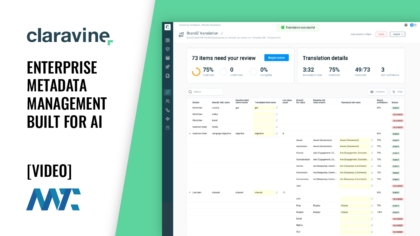
Every marketer knows the feeling. You pull a report, the numbers look off, and the next hour disappears into spreadsheets trying to figure out why one team tagged a campaign one way, and another team did something completely different. Multiply that across agencies, regions, channels, and partners, and the single source of truth everyone keeps talking about starts to feel like a myth. Inconsistent naming conventions, missing metadata, and conflicting taxonomies make it nearly impossible to measure performance with confidence, let alone feed clean data into the artificial intelligence (AI) tools your stack now depends on.
The problem rarely sits with any one team. It’s that data standards live in slide decks and shared documents rather than in the workflows where campaigns are actually built. Without enforcement at the point of creation, governance becomes cleanup work, and cleanup work never ends.
Claravine
Claravine is the Data Standards Cloud, an enterprise platform that lets marketing teams define metadata and taxonomy standards in one place and automatically apply them across all workflows, systems, and channels. It turns governance from a downstream chore into an upstream default.

Claravine gives marketing, operations, and analytics teams a shared data language that travels with every campaign and asset. Instead of relying on training documents or post-launch audits, standards get embedded directly into the tools your teams already use, validated in real time, and pushed through your full marketing stack via no-code connectors and APIs.
The result is faster time to market, fewer hours lost to manual corrections, and metadata that’s actually usable for measurement, optimization, and AI applications. According to Claravine, customers achieve 50 percent taxonomy compliance post-implementation and see time-to-value (TTV) in less than 0 weeks, based on their reported benchmarks.
The platform brings together a connected set of capabilities to standardize, validate, and operationalize marketing metadata at scale.
- Access Management: Organize roles, permissions, groups, and folders so the right people have the right level of control across teams and projects.
- APIs: Pull data and build flexible solutions for campaign orchestration, measurement, and downstream automation that fit how your teams actually work.
- Approvals: Route submitted data or proposed changes to standards through team review before they go live.
- Dashboard: Surface actionable metrics that pinpoint where data is missing, inaccurate, or out of compliance so teams can prioritize what to fix first.
- Data Management: Validate, generate, structure, and apply metadata to both new and existing data wherever your teams work.
- Data Standards: Build your taxonomy from reusable components and bring it to life through accessible, connected, editable templates purpose-built for your organization.
- Enterprise-Grade Uptime: Count on availability that meets enterprise reliability expectations.
- Integrations: Connect Claravine to your existing stack through no-code connectors, import and export options, and partner workflows that fit any system requirement.
- Multi-Factor Authentication: Add a second layer of login security for users.
- SOC 2 Type II Certified: Meet industry-standard practices, policies, and operational controls for data security.
- Spreadsheet UI: Give users a familiar spreadsheet interface to quickly navigate, edit, and manage data.
- SSO Authentication: Simplify sign-on across teams while maintaining security.
- Tag Validations: Catch marketing tag errors in real time at scale, reducing manual checks and post-launch firefighting.
- User Activity Log: Track actions taken by users, managers, and admins from one centralized view.
Over 50 percent of imported data wasn’t compliant until Claravine stepped in.
Claravine
Taken together, these capabilities enable marketing organizations to define standards once and enforce them everywhere, turning metadata into infrastructure rather than an afterthought.
Get started with Claravine
If your team is spending more time reconciling marketing data than learning from it, the fix isn’t another dashboard or another cleanup project. It’s getting standards into the workflow itself. Claravine gives enterprise marketers a way to define metadata and taxonomy once, enforce it automatically, and feed clean, context-rich data into every system that depends on it, including the AI tools shaping what comes next.
Schedule a conversation with the Claravine team to see how standardized metadata can shorten time to market, sharpen measurement, and prepare your data for what’s next.
Schedule a Clarvine Conversation
FAQs
What is marketing metadata, and why does it need to be standardized?
Marketing metadata is the descriptive information attached to campaigns, assets, and tags, such as campaign name, channel, audience, and region. Standardizing it ensures every team, agency, and system uses the same language, which makes reporting accurate and data usable for AI and analytics.
How does Claravine fit into an existing marketing stack?
Claravine connects to your existing tools through no-code connectors, APIs, add-ins, and extensions, so it acts as a layer of governance across what you already use rather than a replacement. Teams keep working in their preferred platforms while Claravine enforces standards behind the scenes.
Who typically owns Claravine inside an organization?
Ownership often sits with marketing operations, data governance, or analytics leadership, but the platform is built for cross-functional use. Marketers, analysts, agencies, and IT all interact with it depending on their role in the campaign workflow.


