The Email Quality Gap: What Most MarTech Stacks Are Missing Before the Send

Most marketing operations teams have done the hard work of assembling a capable stack. The ESP handles delivery and list management. The automation platform manages triggers, segmentation, and journey logic. The CRM feeds audience data. Analytics tools track what happens after the send. Somewhere there’s probably a content calendar, a QA process of some kind, and a template system that keeps campaigns from looking off-brand.
It’s a lot of tooling. And most of it is focused on the wrong part of the email lifecycle.
Everything upstream of the send — building, segmenting, scheduling — gets tool support. Everything downstream — opens, clicks, conversions — gets analytics support. What happens in the window between final approval and go-time, when someone is supposed to verify that the email is actually ready, tends to get a gut check and a test send to a Gmail account. Maybe a colleague glances at the preview.
That’s not a quality system. And the gap it leaves is bigger than most teams realize until something goes wrong at scale.
Subject lines that look clean in the builder but trigger spam filters. Personalization tokens that fail silently when a data field is empty. CTAs that link somewhere but score poorly against audience intent because placement and copy weren’t evaluated. Mobile layouts that collapse in Outlook. Broken alt text on images that carry meaning. These aren’t hypothetical edge cases — they’re the kind of issues that show up in post-send reports after 80,000 contacts have already received something that wasn’t ready to go.
The fix is a structured pre-send quality review. It doesn’t require rearchitecting the stack. It requires adding one step before the send that doesn’t currently exist.
What a Quality Layer Actually Does
Pre-send quality review exists as a practice in most organizations. It usually means someone eyeballs the preview, clicks through the links, and checks that nothing looks obviously broken. That’s accountability, not evaluation. What email campaigns actually need before they go out is structured, multi-dimensional scoring — a consistent framework that catches not just technical errors but quality signals that affect deliverability, engagement, and whether the email earns the attention it’s asking for.
Running campaigns through a dedicated review tool, rather than relying on informal sign-off, shifts quality from a function of who reviewed it to a function of the system. AlpacaRelay’s pre-send scorer analyzes emails across deliverability, engagement, and compatibility — covering the dimensions most likely to affect outcome — and surfaces specific fixes, each addressable with a single click. For teams managing high send frequency, multiple brands, or campaigns built across distributed workflows, this creates something more operationally useful than a checklist: a repeatable output that produces the same review standard every time regardless of who built the email.
AlpacaRelay
AlpacaRelay is an AI email builder with a built-in pre-send scorer that evaluates campaigns across eight quality dimensions and lets teams apply suggested fixes directly in the platform.
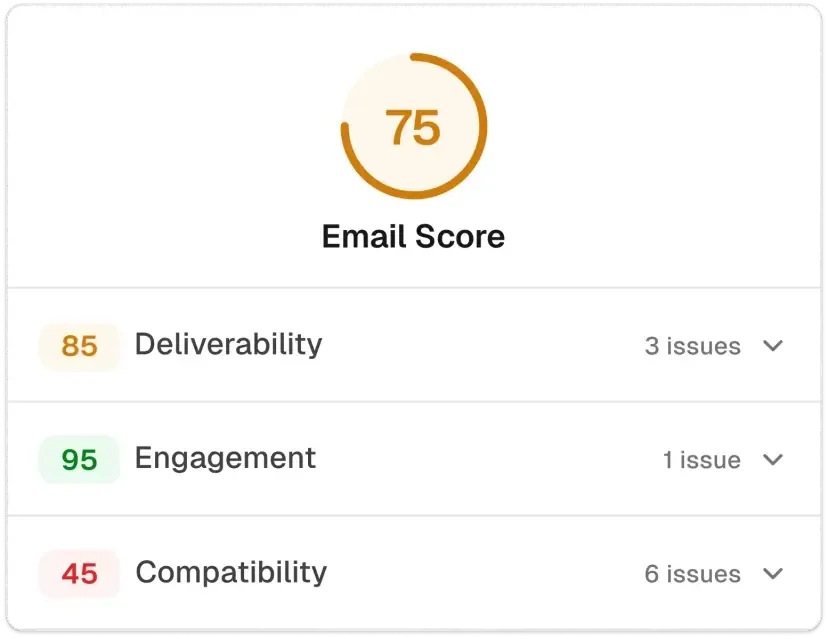
The value compounds at volume. A single missed dimension that clears informal review and goes out to 150,000 contacts creates a problem — in deliverability reputation, in engagement metrics, in the subscriber relationship — that’s orders of magnitude more expensive than the time it would have taken to catch it. Adding a structured scoring step to the pre-send workflow is where most teams get the clearest return on any marginal investment in their stack.
The eight dimensions the scorer evaluates include:
- Accessibility: Checks whether the email meets screen reader and assistive technology standards, including alt text coverage, color contrast ratios, and semantic structure.
- Brand consistency: Evaluates whether visual elements, fonts, and tone align with established brand guidelines across the full email.
- Call-to-action clarity: Scores CTA placement, copy language, and visual prominence against engagement benchmarks.
- Compatibility: Validates how the email renders across common clients and environments, flagging layout patterns most likely to break in specific clients.
- Content quality: Reviews reading level, sentence structure, and copy clarity relative to the intended audience.
- Deliverability signals: Flags content patterns, link structures, image-to-text ratios, and formatting choices that correlate with the risk of spam filtering.
- Mobile optimization: Checks layout and interactive element performance across mobile clients and screen sizes.
- Subject line and preview text: Scores subject line length, keyword density, and preview text pairing for inbox display performance.
These eight dimensions together address the full range of what determines whether a campaign performs — from the first impression in the inbox through to rendering on the device a subscriber actually opens it on. The one-click fix functionality means the review doesn’t become a separate correction loop; issues get resolved in the same session they’re identified, before anything goes out the door.
Add the Step That Protects Every Send
Most MarTech stacks have tooling for every phase of the email lifecycle except the one that determines whether the campaign going out is actually good. Investing in automation, segmentation, and post-send analytics doesn’t recover the performance lost when the email itself had a fixable problem that a structured pre-send review would have surfaced. That layer belongs in the stack like any other critical checkpoint — and it’s the most direct way to close the distance between the campaign you built and the one that should have gone out.
Check Your Email Before You Send
Frequently Asked Questions
What does a pre-send email quality review actually check?
A structured pre-send review evaluates an email against a defined set of quality dimensions before any contacts receive it. Rather than just proofreading for errors, it covers deliverability signals, rendering across clients, personalization configuration, CTA effectiveness, and mobile layout — the factors that affect performance outcomes, not just surface-level accuracy.
Why don’t most ESPs include email quality scoring?
ESPs are built to deliver email reliably at scale, which is a different engineering problem from evaluating content quality. Quality scoring requires analyzing copy, design, deliverability signals, and rendering behavior together — a layer that sits above send infrastructure. That’s why it typically lives outside the ESP and operates as its own tool in the stack.
How is multi-dimension scoring different from a spam checker?
A spam checker evaluates one signal: whether the email is likely to be filtered. Multi-dimension scoring covers a broader quality picture — engagement likelihood, mobile rendering, CTA effectiveness, brand compliance, accessibility — that affects campaign outcomes even when deliverability is technically fine. Most issues that hurt email performance aren’t spam-related at all.