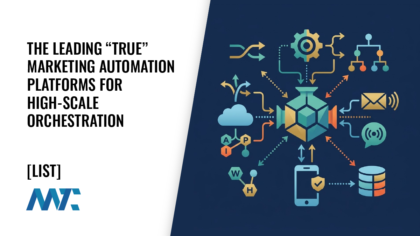
The Leading “True” Marketing Automation Platforms for High-Scale Orchestration in 2026
In the modern MarTech stack, the term marketing automation has become a catch-all that often masks significant technical limitations. For the sophisticated organization, automation is not merely a scheduled email; it is a real-time orchestration engine. To qualify as a genuine provider in this space, a platform must offer a foundational technical quintet: a robust API, webhooks for bi-directional data flow, a dedicated mobile SDK, bulk and triggered sends with deep personalization, and native delivery across Email, SMS, and direct messaging apps like WhatsApp or Slack.
Furthermore, the gold standard includes a visual event tree builder that handles complex logic, branching, and scheduling. The following guide categorizes the top providers that meet these criteria, listing them in alphanumeric order within their respective segments.
Table of Contents
B2C Non-Ecommerce Marketing Automation Platforms
1segment is often underserved by platforms that over-index on retail cart logic. These brands, like streaming services, publishers, and insurance firms, require event-driven triggers based on consumption and behavioral signals rather than just transactions.
Braze
Braze is the enterprise benchmark for high-velocity behavioral data. Originally built for the mobile-first era, it processes customer signals with sub-second latency, allowing for immediate cross-channel responses. Its primary feature set revolves around the Canvas Flow tool, a premier visual journey builder that features Decision Splits, Action Paths, and Experiment Paths.
From a technical edge perspective, Braze mobile SDKs are arguably the deepest in the market, providing granular control over push notifications and in-app messaging. It runs on a modern infrastructure designed for scale. The reality of the platform is that power comes with a high price and requires a technical team to manage the workspace effectively.
Customer.io
A favorite for SaaS and subscription-based B2C apps, Customer.io treats data like a developer would. It is built to respond to API calls and user events in real time. It provides multi-channel messaging across email, push, SMS, and Slack, orchestrated through a visual workflow builder with advanced conditional logic.
The technical edge here is the exceptional support for mobile frameworks like Flutter, React Native, and Expo. Its use of Liquid templating allows for personalization that can transform message content based on complex logic. It is highly affordable but rewards teams that have the technical capacity to feed it clean event data.
MoEngage
MoEngage focuses on AI-powered retention. It is a strong mid-to-high-market choice for mobile-centric brands that need behavioral segmentation and a polished journey builder without the full cost of legacy enterprise systems. It provides a unified view of the customer and focuses heavily on the Propensity to Churn to help marketers intervene before a user leaves the ecosystem.
Insider One
Insider One differentiates itself by integrating on-site personalization directly into the messaging journey. It allows brands to change website layouts or search results using the same triggers that trigger an email or WhatsApp message. For brands that want a consistent experience between the app, the web, and the inbox, Insider offers a consolidated architectural approach.
B2C E-commerce Marketing Automation Platforms
E-commerce requires a specialized data model built around product catalogs, browse behavior, and transaction history.
Klaviyo
Klaviyo is the dominant force in this segment. It unifies email, SMS, RCS, and WhatsApp into a single customer profile, backed by over 350 native integrations. Its Flows builder is purpose-built for the commerce lifecycle, including sequences for abandoned carts, price drops, and back-in-stock notifications.
The technical edge involves a robust API, webhooks, and warehouse syncs. Its predictive analytics can automatically surface expected next-order dates and lifetime value. While it is the leader for D2C, it lacks a B2B CRM and is less effective for non-transactional business models.
Omnisend
Omnisend serves as the primary mid-market alternative to Klaviyo. It is highly optimized for Shopify and WooCommerce, offering a cleaner UI and competitive pricing for brands that need solid multi-channel automation without enterprise complexity. It excels at making SMS and email work in tandem to drive immediate revenue.
Oracle Marketing
Oracle Marketing is a heavyweight in the enterprise e-commerce tier. It is built to handle the massive scale required by global retailers and financial institutions. Its visual orchestration tool helps marketers manage complex cross-channel programs that remain compliant across different global regions. While powerful, it carries a significant implementation weight.
SAP Emarsys
Emarsys is the enterprise answer for global retail. It offers a massive channel footprint, including mobile wallet and direct mail. However, developers often find its SDK documentation and channel-specific analytics to be more fragmented than modern API-first rivals. It is best suited for organizations already deeply embedded in the SAP ecosystem.
B2B Marketing Automation Platforms
B2B marketing automation (SMB to Mid-Market) focuses on the long game: lead scoring, CRM alignment, and multi-stakeholder nurturing.
ActiveCampaign
ActiveCampaign is widely considered the best value in the mid-market. It bridges the gap between a marketing tool and a functional CRM. It handles two-way SMS and WhatsApp integration and offers over 900 pre-built automation recipes.
Its visual builder rivals expensive enterprise tools but starts at a fraction of the cost. It excels at triggering actions based on real-time CRM signals, such as moving a deal to a new stage. The email editor is functional but often lacks the design-forward aesthetic of newer B2C competitors.
HubSpot Marketing Hub
The gold standard for B2B teams under 500 employees. HubSpot strength is its all-in-one ecosystem, where marketing, sales, and service data live in one place. Its visual workflow builder is intuitive and powerful, supporting lead scoring and smart content.
The integration between the website and the automation engine is seamless, making it easy to track a user from their first anonymous click to a closed deal. However, real automation is often locked behind higher price tiers, and advanced direct messaging features may require third-party add-ons.
Enterprise Marketing Automation Platforms
At this level, the requirements shift toward global governance, security compliance, and the ability to process billions of messages.
Adobe Experience Cloud Journey Optimizer
Adobe Journey Optimizer is the modern, API-first orchestration engine within the Adobe suite. It is designed for real-time delivery across email, SMS, push, and web. If an organization is already using the Adobe Real-Time CDP, this tool provides unmatched data synchronization and creative asset integration. Implementation is a massive undertaking requiring certified architects.
Iterable
Iterable is the primary enterprise challenger to the legacy incumbents. It provides a highly flexible data model that appeals to engineering teams. Its Studio builder is exceptionally agile, allowing for complex branching and A/B testing across channels. It is often faster to implement than older enterprise platforms while offering comparable power.
Salesforce Marketing Cloud
Salesforce Marketing Cloud is the default choice for the Salesforce-centric organization. Its Journey Builder is a powerful tool for multi-channel paths and real-time decisioning. The platform’s true power is unlocked through SQL and specialized scripting. With the addition of Agentforce, AI helps generate segments and journey logic. It requires dedicated internal admins or agency support to maintain.
Oracle Eloqua
Eloqua remains a stalwart for complex B2B enterprise needs. It focuses heavily on lead management and sophisticated scoring models. It is the right choice for organizations with global, multi-product B2B programs that require deep integration with a sales CRM and rigorous data routing logic.
Strategic Selection: How to Choose
To select the right platform, stop focusing on the feature list and start focusing on your organizational capacity. The most sophisticated engine in the world is useless if you lack the fuel to run it or the mechanics to maintain it. Modern marketing automation is not a set-it-and-forget-it software purchase; it is a fundamental shift in how your company interacts with its customers. Success requires an honest assessment of your current infrastructure, your budget for hidden costs, and the human capital required to translate data into meaningful journeys.
The following framework outlines the critical pillars of organizational readiness you must evaluate to ensure your chosen platform becomes a driver of growth rather than a stranded asset.
- North Star Channel Alignment: Identify the primary medium where your customers are most active. If your revenue is driven by a mobile app, prioritize platforms with deep SDK support and sub-second in-app messaging latency. If your business is driven by a B2B sales team, prioritize tools with native CRM functionality and lead scoring.
- Engineering and Developer Resources: Audit your technical staff to determine if they can implement a mobile SDK, manage complex API calls, and maintain webhooks. Developer-centric tools like Customer.io or Iterable offer the most flexibility for technical teams, while marketer-friendly platforms leverage low-code capabilities for teams with limited engineering bandwidth.
- Data Gravity and Residency: Evaluate where your customer data currently lives and any legal requirements for its storage. The friction of moving data from an established warehouse to a new tool often outweighs the benefits of a specific feature. Ensure the platform aligns with your Data Gravity to prevent latency and synchronization errors.
- Personnel Training and Experience: Assess your marketing operations team’s current skill set. Enterprise platforms like Salesforce Marketing Cloud or Adobe Journey Optimizer often require specialized certifications and months of training, while mid-market tools are more intuitive. Factor in the cost of hiring specialized talent or upskilling existing employees to avoid execution gaps.
- Total Cost of Ownership and Third-Party Deployment: Calculate the full financial commitment (TCO) beyond the annual software license. This includes implementation fees, the cost of third-party agencies or consultants to build and deploy complex journeys, and potential overage charges for high-volume sends. Often, the cost of the professional services required to stand up the platform can equal or exceed the first-year license fee.
- Operational Process and Governance: Establish clear workflows for briefing, building, testing, and approving campaigns. A platform with a powerful visual builder can lead to chaotic, uncoordinated messaging without a strict Governance framework. Determine who owns the global logic versus regional execution to prevent overlapping or conflicting customer journeys.
- Exception Handling and Edge Cases: Define how the system should react when data is missing or a user falls outside of a standard segment. High-end automation providers allow for sophisticated Exception Handling, ensuring that if an API call fails or a product is out of stock, the customer receives a helpful alternative rather than a broken or irrelevant message.
- Ability to Analyze and Improve Results: Ensure the platform provides metrics beyond surface-level metrics like open rates. You need the ability to perform holdout testing, multi-variant experiments, and attribution modeling. The tool must allow you to analyze and improve by feeding engagement data back into your analytics stack to close the loop on ROI.
- Integration to the Existing Stack: Map out how the platform will talk to your current CDP, CRM, and analytics tools. A true automation provider must support bi-directional data flow via webhooks and APIs. If the platform cannot easily integrate with your Existing Stack, it becomes a data silo that prevents a unified view of the customer experience.
- Service Level Agreements and Global Support: Evaluate the contractual guarantees for platform uptime and message deliverability. A true enterprise SLA should specify credits for downtime and provide tiered support response times based on issue severity. For global brands, this must also include 24/7 technical coverage and localized support to ensure that a critical failure in one region does not paralyze your entire orchestration engine during peak hours.
Selecting a provider is a high-stakes decision that dictates your operational speed for years to come. By moving beyond a simple feature checklist and focusing on these pillars of organizational capacity, you ensure that your marketing automation platform acts as a force multiplier for your team. The right choice is the one that fits your current technical reality while providing a scalable path toward your future customer engagement goals.