The Five Pillars of Omnichannel Marketing in an AI Visibility Age
The acronym changes every few months. SEO became GEO became AEO became LLMO. The vendors selling courses and audits change with it. What rarely changes is the shallowness of the underlying conversation. Much of the generative engine optimization advice circulating right now reads as if it were written by people who have never opened a robots.txt file, have not used a structured data validator, and do not have a working model of how a retrieval-augmented (RAG) system actually decides what to cite.
The harder problem is that almost none of this conversation is happening at the right altitude. AI visibility is not a content development problem. It is an omnichannel orchestration problem. The signals a model uses to summarize, cite, or recommend a brand are pulled from every surface where the brand has a presence, and the brands that show up coherently are the ones whose marketing organizations are actually operating as one.
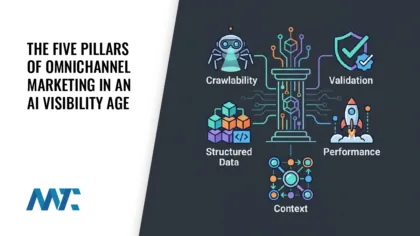
Five pillars hold this up:
- Crawlability: Whether machines can access your content in the first place
- Structured data: Whether they can understand what they are reading
- Validation: Whether your claims are corroborated everywhere else they appear
- Performance: Whether your properties are fast and parseable enough to be worth reading
- Context: Whether you have built the authority and semantic clarity that makes you worth citing
None of them is optional, and none of them works in isolation.
Crawlability
If a bot cannot access your content, nothing else matters. That sounds obvious until you look at how many sites are quietly blocking the very agents they claim to want traffic from.
Know which agents are doing what
GPTBot, ClaudeBot, PerplexityBot, Google-Extended, and the rest each have distinct user agents and distinct purposes. Some are training crawlers. Some are real-time retrieval agents fetching pages on behalf of a user query. Blocking the former while allowing the latter is a defensible position. Blocking everything because someone wrote a panicky blog post about AI scraping is not.
Audit every surface, not just the website
The brands winning at AI visibility are not just optimizing the corporate site. They are auditing every channel for crawler accessibility. Common blind spots include:
- Client-side rendered pages: invisible to most retrieval pipelines, which fetch raw HTML and move on
- Press releases on wire services: often blocked, paywalled, or buried under aggressive bot mitigation
- Video content without text: YouTube videos with no transcripts, descriptions, or chaptering give the model nothing to read
- Locked social profiles: privacy settings that prevent crawler access cut off a major signal source
- Help centers behind login walls: valuable content that no model will ever see
- Microsites with no sitemap: standalone campaigns that nobody told the search infrastructure about
- Podcasts without show notes: audio nobody can parse, with no crawlable surrogate
Get the internal plumbing right
Sitemaps, clean URL structures, and a logical link graph are not relics of decade-old SEO. They are how a crawler decides what is canonical, what is fresh, and what is worth re-fetching. Cross-linking between owned channels gives the crawler a coherent map of the brand’s full presence.
Structured Data
Structured data is the most underused tool in the marketing stack and the one that translates most directly into AI utility.
What schema actually does
Schema.org markup, encoded as JSON-LD, provides a machine-readable (M2M), unambiguous understanding of a page’s content. The machine doesn’t need to interpret the information, since it’s provided as key-value (KV) pairs. It is the difference between handing the system a row from a database and asking it to read your mind.
The schema types most marketing teams underuse
- Article: author, publication date, headline, publisher
- Product and Offer: price, availability, brand, reviews, warranty terms
- FAQPage: explicit questions and answers, the format models love most
- LocalBusiness: hours, service area, coordinates, payment methods
- VideoObject: duration, thumbnail, transcript, upload date
- Event: start time, location, organizer, ticket information
- Organization: unified entity data tying every property back to a single brand
The error most teams make
They add Article markup to every blog post, call it done, and do not apply the same discipline to the channels where structured data would actually make a difference. Beyond the common types, Schema.org has been extended with vocabularies for nearly every industry, all still active in the v30 release as of 2026, and most marketing teams have no idea these exist.
The work of finding the right schema for your industry is genuinely useful and almost universally skipped. A model trying to answer a specific question about a vehicle, a procedure, a property, or a course is far more likely to cite the source that declared its content in the precise vocabulary built for that domain than the source that buried the same information in generic Article markup. Industry extensions worth knowing:
- Automotive: Vehicle, Car, BusOrCoach, Motorcycle, MotorizedBicycle, and CarUsageType for dealer inventory, fleet, and rental listings
- Healthcare: MedicalCondition, Physician, Hospital, MedicalProcedure, and Drug for clinical and provider content
- Real estate: Residence, Apartment, House, ApartmentComplex, and SingleFamilyResidence for property listings
- Financial services: FinancialProduct, BankAccount, LoanOrCredit, MortgageLoan, and InvestmentOrDeposit for products and accounts
- Education: Course, EducationalOccupationalProgram, and EducationalOrganization for programs and institutions
- Hospitality: LodgingBusiness, Hotel, Restaurant, MenuItem, and Reservation for bookings, dining, and stays
- Software and SaaS: SoftwareApplication, WebApplication, and MobileApplication, each with version, operating system, and pricing properties
The work of finding the right schema for your industry is genuinely useful and almost universally skipped. A model trying to answer a specific question about a vehicle, a procedure, a property, or a course is far more likely to cite the source that declared its content in the precise vocabulary built for that domain than the source that buried the same information in generic Article markup.
Validation
Validation is where most of the GEO conversation falls apart, because it’s treated as an on-site concern. It is not.
What validation actually means
Validation is the process of ensuring the claims your brand makes anywhere are corroborated by every other trusted source on the internet that mentions you. AI systems are probabilistic. When a model is asked a question that touches your brand, it is weighing signals from every source it can pull into context, and the answer it produces is a probability distribution across those signals.
What the model is cross-referencing
- Your website: The home base for nearly every claim
- Google Business Profile: Location, hours, services, reviews
- Social channels: Bios, descriptions, posted content, engagement
- Directories and listings: Apple Maps, Yelp, industry-specific platforms
- Press and trade publications: Earned mentions and citations
- Review platforms: Sentiment, ratings, response patterns
- Video and podcast platforms: Descriptions, channel metadata, host bios
- Professional networks: LinkedIn company pages and executive profiles
What goes wrong when these disagree
If those signals disagree, the model has a problem. Two different addresses, three different phone numbers, a service area on the website that does not match the GBP, an old logo on Yelp, a closed location still listed on Apple Maps, an executive bio on LinkedIn that contradicts the one on the corporate site, and a YouTube channel description that names a different value proposition (UVP) than the homepage. Each inconsistency lowers the model’s confidence that any single version is correct.
The practical consequence is that the model either picks the wrong version, hedges with a vague answer, or declines to cite you at all and goes to a competitor whose data tells a coherent story.
Beyond NAP
NAP consistency is the most familiar version of this problem and still the most commonly broken. But the discipline extends well beyond local SEO:
- Product specifications: consistent across retail channels and feeds
- Author and executive bios: identical credentials, titles, and affiliations everywhere they appear
- Messaging: paid and organic, saying the same thing
- Company facts: founding dates, headcount, certifications, awards, and leadership
- Brand positioning: the same value proposition across every property
Why most brands fail at this
Validation requires the most ongoing operational discipline, and it most exposes the dysfunction in how marketing organizations are structured. The website is owned by one team, the social channels by another, the GBP by a local team, the directories by an agency, the video channels by content marketing, the press relationships by communications, the paid campaigns by demand gen, and the product copy by product marketing. Nobody is running the orchestration.
Performance
Core Web Vitals (CWV) were not invented for AI agents, but AI agents inherit the same constraints that gave rise to them.
Why speed determines what gets read
A slow page is a page that the crawler may abandon before fully rendering. Every retrieval system has a fetch budget. The retrieval bot is just another user agent with limited patience.
The metrics that matter:
- LCP: How quickly does the main content actually appear?
- INP: How responsive is the page to input?
- CLS: whether the page is stable as it loads
Architecture decides what gets parsed
A page where the actual content is buried under hundreds of kilobytes of JavaScript, third-party (3P) tags, and DOM mutations may render fine for a human waiting four seconds, but a retrieval agent that grabs the initial HTML response and moves on will see almost none of it. Server-rendered or statically generated pages, with progressive enhancement layered on top, remain the most defensible architecture. CMS choices matter here, and many of the platforms marketing teams choose for ease of editing produce front-ends that are catastrophic from a parsing standpoint.
Performance failures across channels
- Video thumbnails that take forever to load: Lost engagement before the play button is even clicked
- Embeds that fail without JavaScript: Invisible to most parsers
- Paid landing pages buckling under tag manager bloat: Killing the very campaigns paying for the traffic
- Email web versions nobody tested: Rendered as garbage when forwarded or archived
- Microsites built for visual flexibility: Beautiful for designers, opaque to machines
The tooling here is excellent, and the excuses are weak. PageSpeed Insights, Chrome User Experience (CrUX) data, Lighthouse, WebPageTest, and the waterfall views inside any browser’s dev tools will tell you exactly where the bottlenecks are. Fixing them is engineering, not marketing.
Context
Context is the pillar the GEO crowd talks about most and understands least, in part because it operates on multiple levels at once. The most concrete level is semantic HTML. The least concrete is reputation built across an entire marketing presence. Both matter.
Semantic HTML: the markup level
A page built from properly nested headings, with a single h1 that announces what the page is about and h2s and h3s that subdivide it logically, is one that gives a parser a free outline. A page built from divs with classes named after visual styles is a page where the parser has to guess.
The semantic elements that matter:
- article: The actual content of the page
- section: Logical divisions within content
- nav: Navigation, not content to be summarized
- aside: Supplemental, not primary
- header and footer: Orientation, not body
- figure and figcaption: Images with their captions properly associated
Accessibility and AI readability converge here, because both depend on the same underlying discipline of writing HTML that means what it says. The CMS the marketing team chose, and the templates the development team built on top of it, determine whether this discipline is even possible at scale.
Site structure: the topical level
A topic cluster with a strong pillar page and a network of supporting articles linking back to it is legible to a model in a way that a flat archive of disconnected posts is not. The same logic applies across channels:
- YouTube: organized into coherent playlists with descriptive metadata
- Podcasts: clear show notes, topic taxonomies, consistent guest framing
- Social: reinforcing the same handful of subject areas rather than chasing every trend
- Press: placing executives as authorities on a defined set of topics
Authority: the reputation level
E-E-A-T is not a metadata field. Experience, expertise, authoritativeness, and trustworthiness are emergent properties of an entire body of marketing output, inferred by language models reading across every channel.
What models weigh when assessing a brand:
- Consistent expert publishing: Executives and team members writing in their actual area of expertise over time
- Trade publication citations: Earned coverage in the publications that matter to your industry
- Demonstrated knowledge: Content that shows a working understanding rather than asserting it
- Substantive social engagement: Participation in real industry conversations
- Corroborating customer signals: Reviews and testimonials that match the brand’s own claims
How context actually gets built
Building context is a sequence, not a switch:
- Define the topical territory: Decide what the brand should be known for and resist the temptation to be known for everything
- Identify the human voices: Name the executives, experts, and authors who will carry that authority
- Produce primary work: Original research, opinion, analysis, and demonstration that nobody else can produce
- Distribute consistently: The same expertise showing up across owned, earned, and social channels
- Reinforce with structured data and semantic markup: So machines can parse what humans recognize
- Audit and recommit: Topical authority erodes if it is not maintained
The corollary is that context cannot be retrofitted with prompts or GenAI content. A brand publishing generic, model-produced articles indistinguishable from a thousand other brands is providing no signal a retrieval system can use to prefer it. The systems are getting better at detecting this, and the long-term trajectory is clear.
The Synthesis
These five pillars are not a checklist. They are a system, and that system spans every channel the brand operates. The failure modes:
- Perfect structured data with unreadable performance: The data is there, but nobody can wait long enough to read it
- Elite content with a hostile robots.txt: The work exists, but the door is locked
- Immaculate onsite signals with a chaotic citation graph: The website tells the truth, but every other source contradicts it
- All of the above with an unsemantic CMS: Every reader, human and machine, has to work harder than they should
The work is to hold all five in tension, audit each across every channel, and resist the temptation to chase whichever acronym is being marketed this quarter.
This is also why AI visibility is fundamentally an organizational problem before it is a technical one. The brands that will be cited by AI systems in five years are the ones who orchestrate marketing as a single coherent function rather than a collection of channel silos, who took technical SEO seriously when nobody was watching, who built editorial and executive authority over a decade of consistent work, who treat their infrastructure as a first-class deliverable, who keep their data clean across every property they appear on, and who understand that machines read the same signals humans do, only faster, more literally, and across every surface at once.
The fundamentals were always the answer. The acronyms were always the distraction.