ZeroGPT: The Fastest Way to Verify Human-Written Content
The rapid adoption of generative AI has transformed how content is produced, edited, and distributed. For publishers, educators, agencies, and enterprise teams, speed introduces a new risk: losing confidence in authorship, originality, and compliance. Traditional plagiarism tools struggle to distinguish between human writing and modern large language models, while manual reviews are no longer realistic at scale. As GenAI text becomes more fluent and accessible, organizations need reliable ways to assess content authenticity without disrupting workflows or compromising privacy.
ZeroGPT
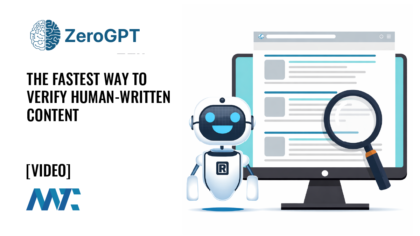
ZeroGPT is an AI content detection and writing-support platform designed to identify text generated by today’s most advanced language models while also providing tools to refine, summarize, and validate content. It serves as a centralized environment for organizations that need clarity around authorship in an AI-first publishing landscape.

Relying on AI detection is no longer about policing writers or discouraging the use of generative tools. It is about preserving trust with readers, students, clients, and regulators at a time when the origin of content is increasingly challenging to determine. As AI becomes embedded in everyday writing workflows, brands face a new reality: the risk is not that AI is used, but that it is used without accountability, oversight, or editorial judgment. This is where a human-in-the-loop, or HITL, approach becomes essential.
Platforms like ZeroGPT illustrate how AI detection can serve as an enabling layer rather than a punitive one. Through multi-stage analysis that evaluates content at both macro and micro levels, teams gain insight not only into whether text may be AI-generated, but where that likelihood exists within a document. This level of transparency supports informed decision-making. Editors, marketers, educators, and compliance teams can review flagged passages, assess intent, and determine whether revisions, disclosures, or additional human input are needed before publication.
A HITL workflow acknowledges an important truth: AI is exceptionally good at accelerating drafts, summaries, translations, and ideation, but it lacks situational awareness, ethical judgment, and brand accountability. Without human review, AI-generated content can inadvertently introduce factual errors, tone mismatches, regulatory risks, or concerns about originality. Detection tools help surface these risks early, but it is the human reviewer who provides context. They understand audience expectations, legal obligations, and brand voice in ways no model can fully replicate.
For brands operating at scale, especially across regions and languages, this balance becomes even more critical. ZeroGPT’s support for multilingual content, bulk uploads, and downloadable reports enables consistent global standards without slowing production. Instead of forcing teams to choose between speed and integrity, HITL workflows supported by detection tools allow both. AI handles volume and velocity, while humans retain authority over quality, accuracy, and trustworthiness.
Importantly, introducing a HITL process also sends a strong signal internally and externally. Internally, it reassures writers and creators that AI is a tool to support their work, not replace their expertise or undermine their credibility. Externally, it demonstrates to audiences and regulators that the brand takes content governance seriously. In industries such as education, healthcare, finance, and publishing, this commitment can be the difference between sustained trust and reputational damage.
As generative AI continues to evolve, brands that succeed will not be those that ban it outright or adopt it blindly. They will be the ones that design thoughtful workflows where AI and humans collaborate, each playing to their strengths. AI detection becomes a checkpoint, not a verdict, and human review becomes the final authority. By embedding HITL principles into content generation, brands protect not only the originality of their work, but the credibility that underpins long-term relationships with their audiences.
Features That Power Reliable AI Detection
ZeroGPT combines detection with a broader set of writing and validation tools. The following features are listed alphabetically and reflect how the platform supports both analysis and improvement within a single workflow.
- AI checker free: Analyze text instantly to identify whether content was written by AI or a human, with highlighted sentences and an overall confidence score, all without requiring payment or account upgrades, making it ideal for quick checks, classrooms, and editorial reviews.
- AI Content Detector: Uses a multi-stage deep learning methodology to evaluate whether text was likely generated by modern language models, including GPT-class systems, while reducing false positives and negatives.
- AI Grammar Checker: Reviews grammar, spelling, and punctuation to improve clarity and professionalism without altering intent.
- AI Humanizer: Refines AI-generated text into more natural, human-like language while preserving meaning and tone.
- AI Paraphraser: Rewrites content to adjust voice, improve originality, or repurpose text for different audiences.
- AI Summarizer: Condenses long-form content into concise summaries while maintaining the original context.
- AI Translator: Provides multilingual translation with an emphasis on accuracy and contextual relevance.
- Batch File Upload: Enables background processing of multiple documents at once, ideal for classrooms, editorial teams, and agencies.
- PDF Detection Reports: Automatically generate downloadable reports documenting AI detection results for audits, compliance, or internal review.
- Plagiarism Checker: Identifies duplicated content across large datasets alongside AI-generation analysis.
- Word Counter and Text Analysis: Offers real-time word counts, keyword density insights, and estimated reading or speaking time.
Together, these capabilities position ZeroGPT beyond a simple checker. It functions as a content validation layer that can be integrated into review, approval, and publishing processes without adding friction.
Get Started with ZeroGPT
Using ZeroGPT is straightforward. Users paste text or upload files directly into the interface and run an analysis that highlights sentences flagged as likely AI-generated, accompanied by a confidence gauge. For organizations, batch uploads and exported PDF reports allow detection to become part of a standardized workflow. Teams that require deeper integration can access ZeroGPT’s API to embed AI detection, plagiarism checks, and text processing directly into their own platforms.
ZeroGPT extends beyond the browser by supporting use within messaging platforms such as WhatsApp and Telegram, allowing quick checks and text refinement from anywhere. This flexibility reflects how content teams actually work today, moving between devices, channels, and collaboration tools throughout the day.
If maintaining content integrity is critical to your brand, classroom, or organization, ZeroGPT provides a practical way to verify authorship, document originality, and adapt to an AI-driven content landscape. Explore ZeroGPT’s AI detection tools and see how confidently validating content can become part of your everyday workflow.