Influencer Marketing Strategies: A Practical Framework for Sustainable Growth in 2026

Influencer marketing has evolved from an experimental channel into a core pillar of modern marketing strategy. As audiences grow increasingly skeptical of traditional advertising, trusted creators have become powerful conduits for awareness, credibility, and conversion. What separates successful programs from costly misfires is not the size of an influencer’s following, but the discipline of the strategy behind the partnership.
Effective influencer marketing is deliberate. It aligns business objectives with audience insight, creator authenticity, and measurable outcomes. The following framework distills proven practices into a cohesive strategy that works across industries, platforms, and campaign types without relying on any single tool or vendor.
Table of Contents
Why Influencer Marketing Works
At its core, influencer marketing is digital word of mouth (WOM). People trust recommendations from individuals they perceive as credible, relatable, or authoritative within a given domain. When a creator naturally integrates a product or service into their content, it triggers social proof and reduces perceived purchase risk.
This trust compounds over time. Repeated exposure to the same creator advocating for a brand builds familiarity, reinforces credibility, and strengthens brand recall. Long-term partnerships consistently outperform one-off promotions because they mirror how trust is built in genuine relationships: through consistency and authenticity.
Establishing a Strong Foundation
Every influencer marketing strategy begins with clarity. Without well-defined goals, campaigns drift toward vanity metrics that look impressive but deliver little business value.
Start by identifying high-level outcomes, such as improving brand awareness, reducing customer acquisition costs (CAC), accelerating trust-building in long sales cycles, gathering product feedback, or strengthening retention. Each goal should then be paired with measurable objectives that define success in concrete terms. A reduction in acquisition costs, a lift in engagement among a specific audience segment, or an increase in qualified traffic are all examples of objectives that can be tracked and optimized.
Equally important is defining the audience with precision. Demographics alone are insufficient. Effective strategies account for psychographics, including interests, values, pain points, and content consumption habits. Understanding whether your audience prefers short-form video, long-form tutorials, or community-driven discussions directly informs which creators and content formats will resonate.
Understanding Influencer Tiers and Their Role
Influencers generally fall into four tiers, each serving a different strategic purpose.
- Nano-influencers (1,000–10,000 followers): What they lack in reach, they make up for in authenticity. Their audiences tend to be highly trusting and tightly knit, resulting in engagement rates exceeding 8%. Nano-influencers are especially effective for grassroots awareness, product seeding, and community-driven campaigns where credibility matters more than scale, and they are frequently open to product-based or modestly paid partnerships.
- Micro-influencers (10,000–100,000 followers): These creators typically operate within clearly defined niches and have built loyal, engaged communities around specific interests or expertise. With engagement rates commonly ranging from 3–6% and typical rates between a few hundred and a few thousand dollars per post, micro-influencers offer one of the most substantial balances between reach, relevance, and cost efficiency.
- Macro-influencers (100,000–1 million followers): Macro-influencers provide broader exposure and more polished, professional content production. While engagement rates generally fall in the 1.5–3% range, their ability to reach larger audiences can justify higher costs, particularly for awareness-focused campaigns or launches that require momentum at scale.
- Mega-influencers (over 1 million followers): These high-profile creators and public figures deliver massive reach and instant visibility but often at premium price points, frequently starting at five figures per post. Engagement rates tend to be lower, typically under 1.5%, making mega-influencers best suited for large-scale brand awareness initiatives rather than highly targeted or performance-driven campaigns.
The most effective strategies focus less on reach alone and more on relevance. A smaller creator whose audience closely aligns with your target customer often delivers greater impact than a larger creator with superficial overlap.
Building a Shortlist of the Right Creators
Discovering the right influencers requires both qualitative and quantitative evaluation. Social platform searches, community exploration, and competitive analysis help surface creators already producing relevant content. Beyond discovery, vetting is critical.
Strong candidates demonstrate consistent engagement, authenticity with the audience, and alignment with brand values. Engagement quality matters more than volume: meaningful comments, repeat interactions, and community dialogue signal genuine influence.
Evaluating past partnerships provides insight into how creators collaborate, whether they elevate campaigns creatively, and how they handle audience feedback. This diligence protects brand reputation and sets the stage for productive, long-term relationships.
Budgeting With Intent
Budget decisions should follow audience behavior, not assumptions. Where your audience spends time determines where investment is most effective. Costs vary widely by content format, influencer tier, campaign duration, and usage rights.
Beyond creator fees, strategic budgets account for content usage permissions, exclusivity clauses, production complexity, timelines, and paid amplification. Many of the strongest influencer programs integrate paid media to extend the reach and longevity of top-performing creator content, especially when driving conversions or targeting specific segments.
Clear budget frameworks also foster stronger partnerships. Transparency enables creators to plan appropriately and ensures expectations are aligned from the outset.
Planning and Content Development
Once strategy and partners are defined, planning shifts toward execution. A well-crafted campaign brief acts as a shared reference point, outlining objectives, messaging priorities, deliverables, timelines, and brand guidelines. The most effective briefs provide direction without stifling creativity.
Creators understand their audiences better than any brand ever could. Inviting them into the creative process early allows campaigns to benefit from their cultural awareness and storytelling instincts. The result is content that feels native to the platform and authentic to the audience.
Formalizing permissions and content rights during this stage prevents friction later, particularly when content will be repurposed or amplified through paid channels.
Launching and Managing the Campaign
The campaign launch is both a technical and a relational milestone. Final checks ensure content aligns with goals, links function properly, tracking is in place, and internal stakeholders are prepared for increased visibility or inquiries.
Once live, active participation matters. Brands that engage with influencer content, respond thoughtfully to comments, and participate in the conversation amplify reach and humanize their presence. Monitoring sentiment and performance in real time allows teams to adapt quickly if conditions change or opportunities emerge.
Paid amplification should follow performance. Identifying which content resonates most and scaling it strategically maximizes return while preserving authenticity.
Measuring Performance and Learning Forward
Measurement transforms influencer marketing from an experiment into a repeatable growth engine. Key metrics span awareness, engagement, and conversion, including reach, interaction rates, traffic quality, sales impact, and audience sentiment.
Effective reporting does more than summarize results. It surfaces patterns that inform future decisions, such as which influencer tiers perform best, which content formats drive action, and how influencer campaigns interact with other marketing channels.
Regular analysis encourages continuous improvement. Short feedback loops during campaigns enable optimization, while deeper post-campaign reviews inform long-term strategy and partner selection.
Managing Risk and Compliance
Clear disclosure practices and platform compliance are non-negotiable. Sponsored content must be transparent, and expectations should be documented clearly in agreements. Proactive monitoring and predefined response plans help brands navigate potential issues quickly and professionally.
Risk management is not about control; it is about preparedness. When challenges arise, brands that respond with empathy and clarity often strengthen trust rather than erode it.
Influencer Marketing Campaigns
Influencer marketing is most effective when it extends beyond a single tactic and instead leverages a mix of campaign formats aligned to different stages of the customer journey. Some strategies are designed to spark discovery, others to build trust over time, and others to drive measurable action.
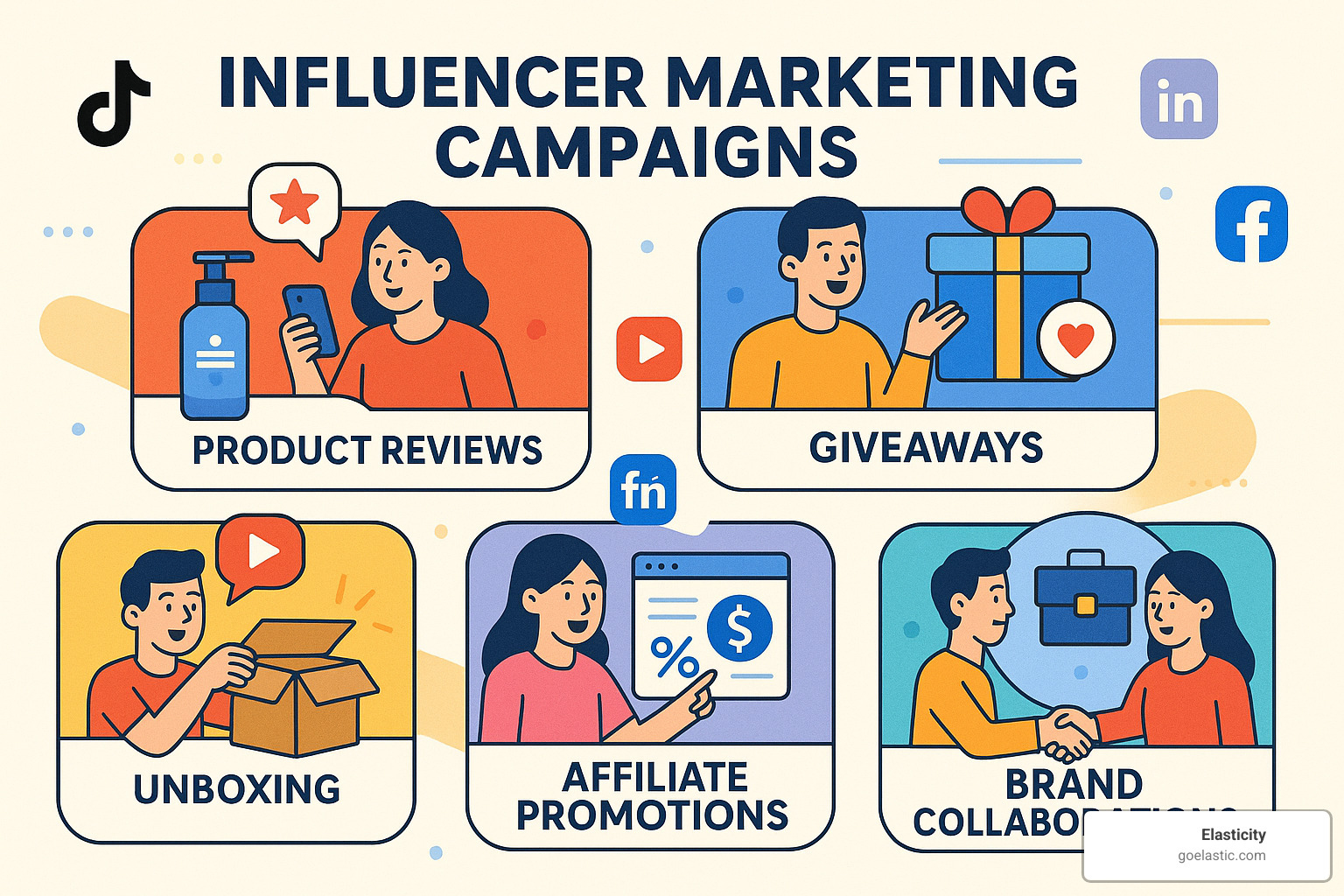
Understanding the range of available campaign types allows brands to be intentional about how creators are activated—and where creativity can be pushed further.
- Affiliate promotions: These campaigns connect influencer activity directly to revenue through unique links or discount codes. They are especially valuable for performance-driven goals because they provide clear attribution while allowing creators to integrate promotions organically into their content.
- Brand collaborations: Collaborations elevate influencers from promoters to partners. This strategy often includes co-created content, recurring integrations, or even limited-edition products, signaling deeper alignment and building long-term brand credibility with the audience.
- Brand sponsorships: Sponsorships emphasize sustained awareness rather than short-term spikes. Influencers consistently reference or feature a brand over an extended period, embedding it into their ongoing content and reinforcing familiarity through repetition and context.
- Challenges and hashtag campaigns: These campaigns encourage audience participation by inviting followers to create and share content around a branded theme. When executed well, they generate significant earned media and foster a sense of community around the brand.
- Educational or tutorial content: Educational campaigns focus on teaching rather than selling. Tutorials, demos, and walkthroughs are particularly effective for complex products or services, helping audiences understand value through practical application.
- Event-based partnerships: Influencers amplify the reach of physical or virtual events through pre-event promotion, live coverage, and post-event recaps. This strategy extends the lifespan of an event and brings the experience to audiences who could not attend.
- Giveaways: Giveaways are a powerful tool for rapid engagement and audience growth when the incentive is closely aligned with the influencer’s niche. Their effectiveness depends on attracting relevant participants rather than solely maximizing volume.
- Product reviews: Reviews remain one of the most trusted influencer formats. By sharing firsthand experiences and honest perspectives, creators help audiences evaluate options and reduce hesitation during the consideration stage.
- Social takeovers: In a takeover, influencers temporarily create content for a brand’s own channels. This injects a fresh voice into branded spaces and exposes the influencer’s audience directly to the brand environment.
- Unboxing campaigns: Unboxing content leverages anticipation and first impressions. These campaigns work exceptionally well for physical products, where packaging, presentation, and immediate reactions shape perceived value.
Taken together, these strategies form a flexible toolkit rather than a rigid playbook. The strongest influencer programs often blend multiple formats and encourage creators to experiment beyond standard executions. Brands that invite originality and co-creation—rather than prescribing rigid templates—are far more likely to produce campaigns that feel distinctive, resonate deeply with audiences, and deliver outsized impact.
A Strategic, Long-Term Perspective
Influencer marketing delivers its most significant value when treated as a long-term investment rather than a series of disconnected campaigns. Authentic relationships, consistent messaging, and disciplined measurement compound over time.
The brands that succeed in this space prioritize alignment over scale, trust over transactions, and learning over perfection. By grounding influencer marketing in strategy, collaboration, and accountability, organizations can build programs that drive tangible business outcomes while fostering genuine connections with their audiences.
Influencer marketing is no longer about borrowing attention. It is about earning trust, one partnership at a time.