Mobile Advertising in 2025: The Essential Guide

The average mobile user today is continually connected, tapping into a digital stream of information, entertainment, and social interaction at all times of the day. With smartphones often the last thing they see before they sleep and the first thing they reach for upon waking, mobile devices have become deeply ingrained in daily life. This constant connectivity provides a fertile ground for mobile advertising, offering an ideal strategy for businesses to reach consumers where they are most active and attentive.
The typical user’s behavior of frequently checking their device—whether for updates, messages, or news—creates numerous opportunities for advertisers to present their messages in a highly targeted and contextually relevant manner. Mobile advertising taps into this routine, delivering tailored content that aligns with users’ interests and habits, making it a potent tool for engaging modern consumers.
Mobile advertising delivers promotional content to users via smartphones and tablets. This year, it matters more than ever, given the ubiquity of mobile devices and the increasing time people spend on them. As smartphones become more sophisticated, the opportunities for brands to engage with consumers personally and interactively are vast.
Mobile Advertising Statistics
The global mobile advertising market is expanding rapidly, rising from USD 214.59 billion in 2024 to a projected USD 1,005.96 billion by 2032, reflecting a 21.1 percent CAGR. Growth is driven by widespread smartphone adoption, increased mobile internet usage, and the accelerating shift of commerce and media consumption to mobile channels.
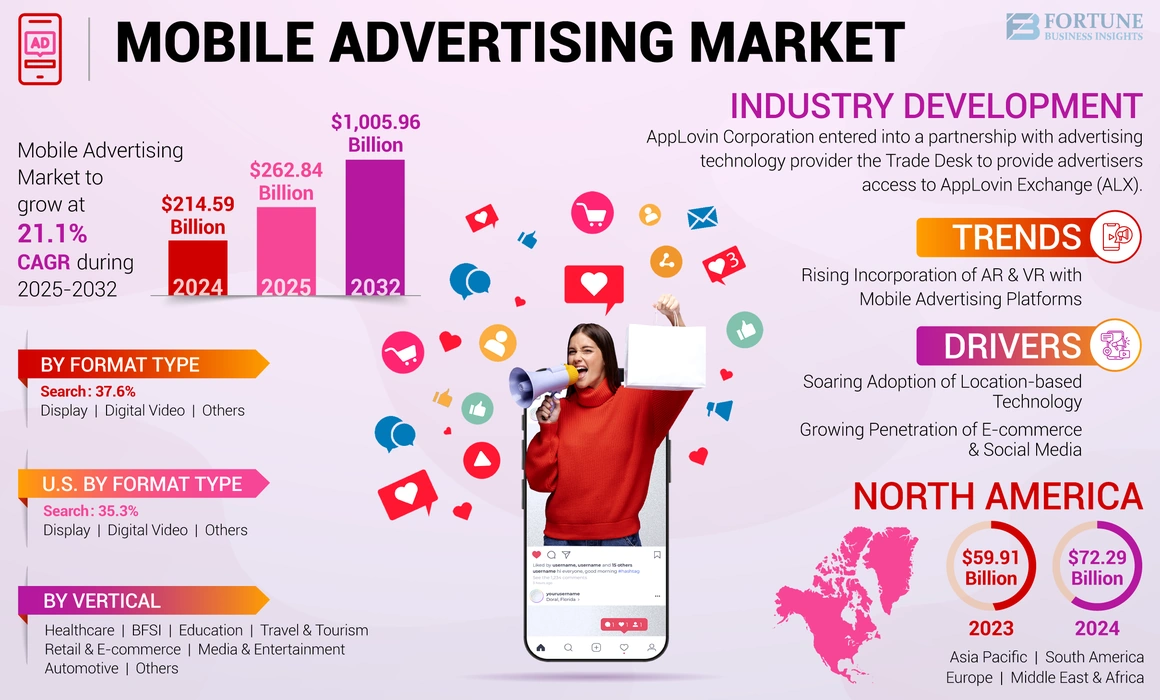
North America leads the market, with the U.S. alone expected to reach USD 142.68 billion by 2032, while the Asia Pacific is on track to become the fastest-growing region. Advances such as AR and VR, rising e-commerce activity, location-based targeting, and higher social media engagement are reshaping mobile ad strategies and deepening personalization. At the same time, persistent privacy concerns and data-security breaches remain barriers to adoption. Search and digital video formats dominate, supported by the retail, e-commerce, and media sectors, which increasingly rely on mobile advertising for customer acquisition and engagement. Major players, including Meta, Google, AppLovin, Chartboost, and InMobi, continue to expand through partnerships, acquisitions, and AI-driven innovations.
- Global market will grow to USD 1,005.96 billion by 2032 at a 21.1 percent CAGR.
- North America held 33.69 percent market share in 2024, with strong long-term U.S. growth.
- AR and VR technologies are emerging as major catalysts for immersive mobile advertising.
- Location-based marketing is a primary driver of adoption across brands and retail sectors.
- E-commerce expansion and rising mobile content consumption continue to accelerate demand.
- Privacy concerns and cybersecurity incidents remain significant restraints.
- Search advertising leads the market today, with digital video projected to grow fastest.
- Retail, e-commerce, and media & entertainment verticals contribute the strongest revenue.
- Asia Pacific is set to experience the highest growth due to smartphone and internet expansion.
- Industry players are strengthening their positions through collaborations and AI-powered tools.
The mobile advertising market is entering a period of transformative growth, fueled by technological innovation, deeper personalization, and expanding digital behaviors across every global region. While security and privacy concerns introduce friction, the overall trajectory remains strongly positive, positioning mobile as the central engine of digital advertising strategy through 2032 and beyond.
Key Advantages of Mobile Advertising
Mobile advertising offers a host of benefits that cater to the dynamic needs of modern businesses and consumers alike. From the cost savings to the personalized user experiences, the strategic advantages of mobile advertising are numerous and varied. Mobile advertising remains the front-runner of advertising because it offers several advantages over traditional advertising mediums:
- Cost-Effectiveness: It can be more cost-effective due to targeted reach and lower production costs.
- Data-Driven: Targeting is refined through data, enhancing ad relevance and performance.
- Immediacy: Mobile devices are always on hand, allowing for real-time customer engagement.
- Innovation: Continuous technological advancements provide innovative ad formats.
- Interactivity: Mobile ads often involve the user, creating a more engaging experience.
- Location Targeting: Mobile devices enable advertisers to target users based on real-time location data.
- Personalization: Advertisers can tailor messages to individual preferences and behaviors.
- Ubiquity: Mobile devices are ubiquitous, offering unparalleled reach.
- User Engagement: High user engagement rates with mobile devices boost ad effectiveness.
These key advantages underscore the transformative power of mobile advertising, making it an indispensable tool in the marketer’s arsenal. As the digital ecosystem becomes more mobile-centric, the importance of leveraging these strengths cannot be overstated for businesses aiming to thrive in the digital domain.
Mobile Ad Formats, Mediums, and Top Channels
As the digital domain continues to expand, the diversity of formats, mediums, and channels in mobile advertising reflects the need for adaptability and innovation in marketing strategies. This diversity allows brands to craft a multi-faceted approach that aligns with shifting consumer behaviors and technological advancements. By embracing a variety of advertising vehicles, companies can ensure that their message resonates across the spectrum of digital touchpoints, maximizing visibility and engagement in a crowded marketplace.
Formats
- Banner Ads: Small rectangular ads that appear at the top or bottom of the device screen.
- Interstitial Ads: Full-screen ads that cover the interface of their host application.
- In-App Ads: Custom ads within mobile applications, offering high user interaction.
- Native Ads: Advertisements seamlessly integrated into the content of the app or webpage.
- Push Notifications: Tailored alerts that drive engagement and retention.
- SMS and E-Mail: Direct and personalized communication with the audience.
- Video Ads: Short video clips that can play before, during, or after mobile content.
Mediums
- Affiliate Marketing: Leveraging partnerships for broader ad reach.
- Apps: Gaming, utility, or lifestyle applications.
- Content Marketing: Delivering valuable content upon mobile detection to build brand loyalty.
- Omni-Channel Marketing: A seamless user experience across all platforms.
- Social Media Platforms: Instagram, Facebook, Twitter, etc.
- Websites: Websites visited by users with mobile detection.
Channels
- Ad Networks: Companies that connect advertisers to websites and apps that want to host advertisements.
- Search Engines: Google Ads and other mobile search ad platforms.
- Social Media: Due to its vast user base and advanced targeting options, it is still a top channel with extensive user bases and sophisticated targeting.
- Video Networks: High-impact video ads remain dominant, especially in travel.
The key for marketers is to construct a blend that leverages the unique strengths of each format, medium, and channel. The end goal is a comprehensive strategy that not only reaches a wide audience but also delivers compelling content that engages and converts across different platforms. As brands navigate this complex landscape, the right mix can lead to powerful campaigns that drive growth and brand loyalty in an increasingly mobile-first world.
Mobile Ad Scenarios
Mobile advertising’s unique capabilities make it exceptionally effective in a variety of scenarios, leveraging its immediacy, personalization, and versatility. Here are several instances where mobile ads can outperform other advertising mediums:
- Time-Sensitive Promotions: Flash sales or limited-time offers can be communicated instantly to consumers, capitalizing on mobile’s immediacy.
- Location-Based Targeting: For local businesses, ads can be targeted to users within a specific geographical area, making it highly relevant and actionable.
- Personalized E-commerce Recommendations: Utilizing browsing and purchase history, personalized product recommendations can be sent to users, increasing conversion rates.
- Event Promotions: Mobile ads can effectively promote events to users based on their interests and proximity to the event location.
- Travel Updates and Deals: For travelers, mobile ads can offer timely deals on flights, accommodations, and experiences based on their current location or search history.
- In-App Gaming Offers: For mobile gamers, ads offering in-game currency or special offers can be highly engaging and lead to direct in-app purchases.
- Streaming Service Suggestions: With data on viewing habits, streaming platforms can use mobile ads to suggest new shows or movies, increasing user engagement.
- Health and Fitness App Promotions: Targeted ads can offer personalized fitness or diet plans based on the user’s activity history or health goals.
- Retail Flash Sales: Mobile ads can alert users to sudden sales, driving immediate traffic to both online and brick-and-mortar stores.
- Public Transport Alerts: For commuters, mobile ads can provide timely updates on transport schedules, delays, or ticket discounts.
- Real Estate Listings: Targeted mobile ads can show users real estate listings in their desired locations and price ranges, making the search process more efficient.
- Educational Course Enrollment: Educational platforms can target users with ads for courses based on their browsing history or expressed interests, leading to higher enrollment rates.
- Political Campaign Messages: During election seasons, mobile ads can target specific demographics with personalized political messages or reminders to vote.
In each of these scenarios, the unique attributes of mobile advertising—such as its ability to reach users based on their location, interests, and behaviors in real-time—make it a more effective choice compared to traditional advertising mediums.
Best Practices for Optimizing Mobile Ad Spend
In a market where consumers’ attention is the ultimate currency, optimizing mobile advertising campaigns is not just a best practice—it’s a necessity. A well-optimized campaign ensures that every ad dollar spent works harder to engage, convert, and retain users. By fine-tuning various elements of your mobile advertising strategy, you can craft messages that not only reach but resonate with your audience, driving meaningful interactions and business outcomes.
- Create Engaging Content: Design interactive and visually appealing ads.
- Embrace Personalization: Tailor ads to individual preferences for higher conversion rates.
- Diversify Your Platforms: Beyond social media, explore video, websites, and push notifications.
- Invest in Creativity: Stand out with unique and interactive content.
- Leverage Analytics: Use data for decision-making and ad optimization.
- Optimize for Conversion: Ensure your mobile site or app is optimized for easy conversion.
- Test and Measure: Use A/B testing and analytics to measure ad performance.
- Prioritize User Experience: Ensure ads are non-intrusive and add value.
- Understand Your Audience: Utilize data analytics to know the audience’s preferences.
- Use Retargeting Strategically: Remind users who have shown interest in your product or service.
Wrapping up, the roadmap to mobile ad optimization is marked by a series of strategic and creative decisions, each designed to enhance the overall efficacy of your campaigns. In an advertising world that thrives on innovation and relevance, these practices are pivotal in building a robust mobile presence that not only meets the expectations of your audience but exceeds them, fostering loyalty and propelling your brand to new heights.
Diversifying Your Mobile Advertising
Finally, diversifying your mobile ad spend is crucial in 2024. Here are the top 10 reasons to diversify your mobile ad spending according to InMobi from their infographic below.
- Reach Non-Social Media Users: Only about 19% of all time spent on mobile devices is dedicated to social media, highlighting the importance of reaching audiences through other channels.
- Message Receptivity: More than one in five consumers report a positive reception to mobile advertising, demonstrating the potential for impact when messages reach users at opportune times.
- Independent Verification: Leveraging third-party verification services like MOAT ensures key metrics such as ad viewability are measured and validated independently.
- Scandal Avoidance: By diversifying ad placements, brands minimize the risk of their ads being associated with scandalous or negative content.
- Scalability: A diversified approach in mobile ad spending allows campaigns to scale more easily, avoiding over-reliance on a single platform or medium.
- Brand Safety: With 49% of consumers likely to develop a negative perception of a brand if their ads appear next to offensive content, brand safety remains a top priority.
- Managed Services: Utilizing managed service offerings can enhance campaign management and effectiveness.
- Improved ROI: Ads outside of walled gardens, like social media platforms, often yield a better ROI, with vertical video ads seeing 124% higher viewability rates than those on platforms like Instagram.
- Messaging Impact: Ensuring your message is seen and not ignored is crucial, as 32% of Gen Zers report making purchases after interacting with rewarded ads.
- Consumer Receptivity: Ads seen on social media are found to be irrelevant by 44% of consumers, suggesting that messages delivered outside of these platforms may be more effective.
The need for diversification reflects the ever-evolving landscape of mobile user behavior and the importance of reaching consumers across multiple touchpoints.
This year, mobile advertising presents an indispensable opportunity for brands to connect with consumers in a direct and personalized manner. By understanding the benefits, keeping abreast of the latest formats and channels, and applying best practices to optimize ad spend, advertisers can effectively engage their audience and achieve significant ROAS.