Modern Technologies in Internet Marketing That Are Changing the Game
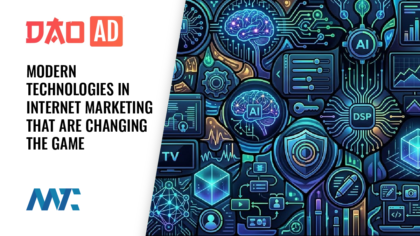
The digital marketing landscape has evolved dramatically over the past few years. What used to be a straightforward process of placing banners and buying clicks has transformed into a complex, data-driven ecosystem powered by artificial intelligence (AI), automation, and hyper-personalized user experiences (UX). Every website with ads now operates within an intricate network of technologies that determine which message reaches which user at what moment. Understanding these technologies is no longer optional — it is essential for any business that wants to stay competitive.
Artificial Intelligence and Machine Learning in Advertising
AI has moved far beyond the experimental stage in marketing. Today, it sits at the core of nearly every major advertising platform, shaping how campaigns are built, optimized, and measured.
Machine learning (ML) algorithms analyze billions of data points in real time to predict user behavior, adjust bids, and allocate budgets across channels without human intervention. Platforms like Google Performance Max and Meta Advantage+ rely entirely on AI to manage creative selection, audience targeting, and placement decisions simultaneously.
Key applications of AI in modern internet marketing include the following.
- Predictive audience modeling. Algorithms identify users who are most likely to convert based on behavioral patterns, purchase history, and contextual signals rather than relying on broad demographic categories.
- Dynamic creative optimization. AI assembles ad variations on the fly — testing headlines, images, and calls to action in thousands of combinations to find the highest-performing version for each audience segment.
- Automated bid management. Smart bidding strategies adjust cost-per-click (CPC) or cost-per-acquisition (CPA) targets every millisecond during real-time auctions, maximizing return on ad spend with minimal manual oversight.
- Conversational AI and chatbots. Intelligent assistants handle initial customer interactions on landing pages and social channels, qualifying leads, and answering questions around the clock.
The impact is measurable. Brands that have adopted AI-driven campaign management report significant improvements in conversion rates and a notable reduction in customer acquisition costs compared to manually optimized campaigns.
Programmatic Advertising and Real-Time Bidding
Programmatic technology has fundamentally changed the way digital ad inventory is bought and sold. Instead of negotiating deals directly with publishers, advertisers use demand-side platforms to bid on impressions across millions of websites and apps within milliseconds.
Real-time bidding works through a transparent auction model where supply-side platforms offer available inventory and demand-side platforms compete for each impression based on how closely the user matches the advertiser’s target profile. The entire transaction — from bid to ad display — happens in under 100 milliseconds.
Several trends are shaping programmatic advertising right now.
- First-party (1P) data activation. With third-party (3P) cookies disappearing, advertisers are building their own data ecosystems using CRM records, loyalty programs, and on-site behavior to fuel programmatic targeting.
- Connected TV (CTV) and digital audio. Programmatic buying has expanded well beyond display banners into streaming television, podcast advertising, and digital out-of-home screens.
- Supply path optimization. Advertisers are auditing the intermediaries between them and publishers to reduce hidden fees and improve transparency in the bidding chain.
Programmatic now accounts for the majority of all digital display spending globally, and its share continues to grow as new channels and formats are integrated into automated buying systems.
Privacy-First Marketing and Cookieless Solutions
The shift toward user privacy has become one of the most disruptive forces in internet marketing. Regulations like GDPR and CCPA, combined with browser-level restrictions on tracking, have forced the industry to rethink how it collects and uses data.
Marketers are adapting through a range of emerging approaches.
- Server-side tracking. Moving data collection from the browser to the server gives marketers more control over what information is captured while respecting consent frameworks.
- Contextual targeting. Rather than following users across the web, contextual technology analyzes the content of a page in real time and serves ads that match the topic, sentiment, or intent of the content itself.
- Data clean rooms. These secure environments allow brands and publishers to match and analyze their first-party datasets without exposing raw user-level information to either party.
- Google Privacy Sandbox. Google’s suite of browser-based APIs designed to enable interest-based advertising, attribution measurement, and fraud detection without individual cross-site tracking.
Companies that invest early in privacy-compliant infrastructure will gain a competitive edge as the industry transitions away from legacy tracking methods.
Marketing Automation and Omnichannel Orchestration
Modern marketing automation platforms go far beyond simple email sequences. They now serve as central orchestration engines that coordinate messaging across email, SMS, push notifications, social media, and paid advertising — all from a single workflow.
The most impactful capabilities of today’s automation systems include the following.
- Behavioral triggers. Actions like cart abandonment, product page views, or content downloads automatically initiate personalized multi-step sequences tailored to the user’s position in the buying journey.
- Lead scoring and segmentation. Machine learning models assign dynamic scores to prospects based on engagement patterns, allowing sales teams to focus on the highest-value opportunities.
- Cross-channel attribution. Advanced models track the complete customer journey across touchpoints, moving beyond last-click attribution to reveal how each channel contributes to the final conversion.
- Lifecycle campaigns. Automated flows manage the entire customer relationship — from onboarding and activation through retention and win-back — without requiring manual campaign launches for each stage.
Businesses that implement full-funnel automation typically see higher customer lifetime value and significantly improved retention rates, since every interaction is timed and personalized based on real behavior rather than guesswork.
What Comes Next for Internet Marketing Technology
The pace of MarTech innovation shows no signs of slowing. Several developments are already on the horizon that will reshape the field once again.
- Generative AI (GenAI) for content production. Large language models (LLM) and image generators are enabling marketers to produce high-quality creative assets at scale, reducing production timelines from weeks to hours.
- Augmented reality advertising. AR-powered product try-ons and immersive brand experiences are moving from novelty to mainstream, especially in e-commerce and retail marketing.
- Voice search optimization. As smart speakers and voice assistants become household staples, optimizing content for conversational queries is becoming a distinct marketing discipline.
- Blockchain-based ad verification. Distributed ledger technology promises to bring unprecedented transparency to impression tracking, fraud prevention, and advertiser-publisher payment settlements.
The marketers who thrive will be those who combine technological fluency with strategic thinking — using these tools not as ends in themselves but as means to build genuine, lasting relationships with their audiences.