Planning Content That Converts: The Content Matrix and RACE Framework

Dr. Dave Chaffey deserves a great deal of credit for bringing structure and clarity to content marketing at a time when most teams were creating content without a clear plan. Through his work at Smart Insights, he did something rare: he aligned the customer journey with human motivation and then mapped those motivations to the types of content people actually engage with.
The Content Marketing Matrix and the RACE Framework are not abstract models. They are working tools designed to help marketers decide what to create, why to create it, and where it fits in the buying journey. Used together, these two frameworks give content teams a way to move beyond random blog posts and disconnected campaigns and toward a system that supports awareness, consideration, conversion, and long-term growth.
Table of Contents
The Content Marketing Matrix, Explained Simply
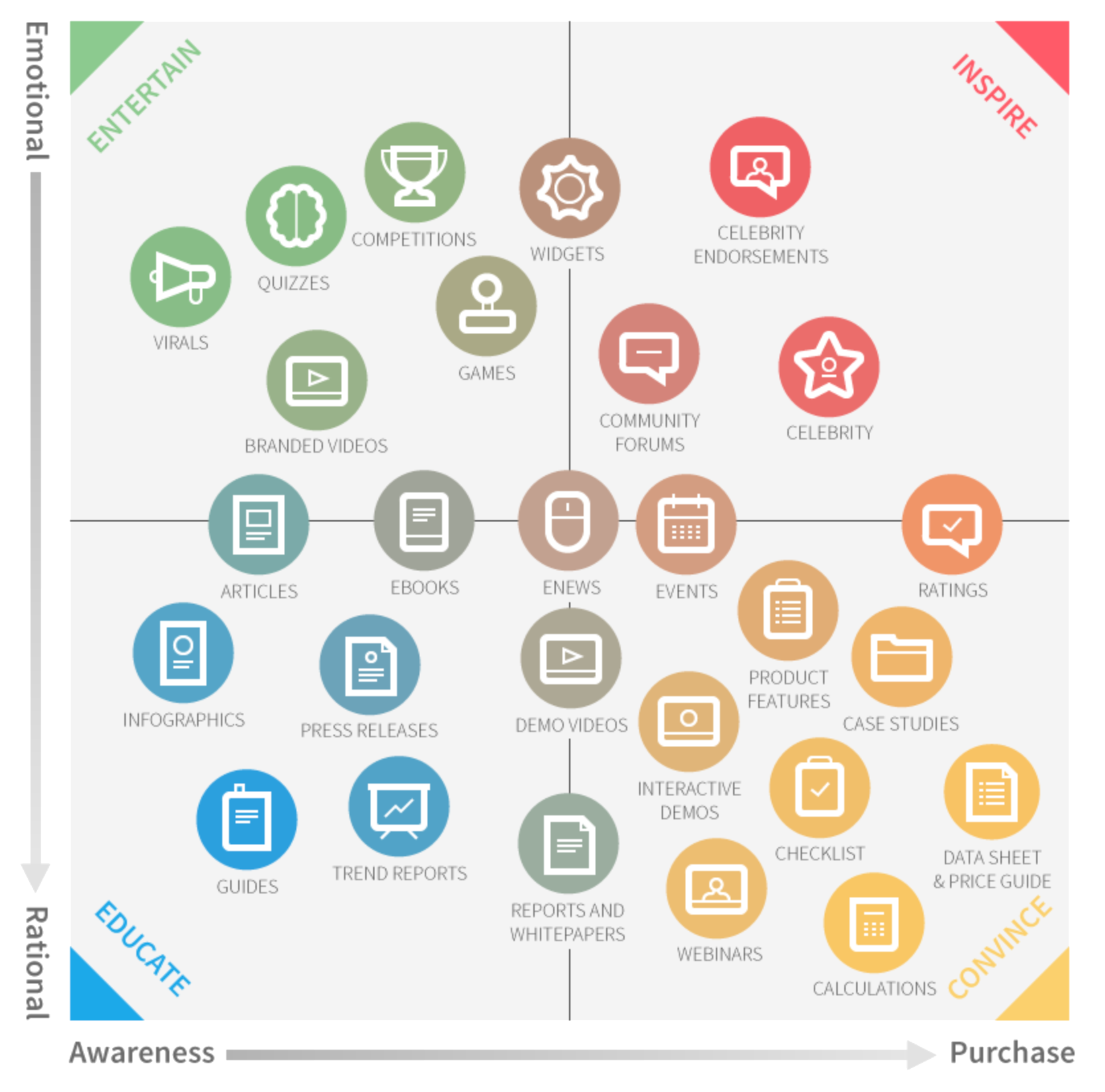
The Content Marketing Matrix exists to answer a fundamental yet often-overlooked question: what type of content should we create to move someone closer to becoming a customer? Instead of starting with channels or formats, the matrix forces you to think about intent and mindset. It helps you audit what you already have and identify gaps where content is missing or over-concentrated.
Awareness to Purchase, Left to Right
The horizontal axis of the matrix follows the path a buyer takes, from first exposure to final decision. Early-stage content is designed to attract attention and spark interest. Mid-stage content helps people learn, compare, and evaluate. Late-stage content supports the buying decision by removing doubt and reinforcing trust.
This lines up naturally with the familiar funnel language of top of funnel (ToFu), middle of funnel (MoFu), and bottom of funnel (BoFu). The value of the matrix is that it makes those stages visible and forces you to ask whether you are actually supporting each one with the right content.
Many teams discover they are strong at awareness but weak at conversion, or heavy on education but light on content that builds initial demand.
Emotional to Rational, Top to Bottom
The vertical axis separates emotional engagement from rational decision-making. At the top of the matrix are content types that trigger curiosity, inspiration, and instinctive interest. These are the pieces people are more likely to notice, remember, and share.
Lower on the matrix are more rational formats that help people justify decisions. These support comparisons, validations, and internal approvals. Both are necessary. People rarely buy based on logic alone, but they almost always need logic to feel comfortable with their decision.
Chaffey often frames this as limbic versus neocortex thinking. In practical terms, it simply means that good content strategies balance how people feel with how they think.
How Marketers Actually Use the Content Marketing Matrix
The matrix is most useful when treated as a working document rather than a static diagram. Teams typically start by plotting their existing content library on the grid. Blog posts, guides, videos, webinars, case studies, tools, and landing pages are all mapped to where they truly belong, not where they were intended to.
This exercise quickly highlights blind spots. It becomes obvious where content is missing, where formats are overused, and where too much effort is being spent without advancing the journey.
From there, the matrix becomes a brainstorming tool. Instead of asking What should we publish next?, teams ask What content do we need at this stage, and what format best fits that mindset? This naturally leads to better ideation and more purposeful content creation.
The matrix also encourages long-term thinking. Evergreen content that attracts links, earns organic traffic, and continues to perform over time becomes easier to identify and prioritize.
Why the RACE Framework Matters
While the Content Marketing Matrix helps define what to create, the RACE Framework helps ensure that content actually works within a broader marketing system. RACE stands for Reach, Act, Convert, and Engage. It provides a clear structure for planning, executing, and measuring digital marketing activity across the full customer lifecycle.

Unlike linear funnels, RACE is designed to be ongoing. It emphasizes continuous improvement (CI), using data to refine performance at every stage rather than treating campaigns as one-off efforts.
Reach: Get In Front of the Right Audience
Reach is about visibility and discovery. Content here is designed to attract attention and drive qualified traffic through search, social, paid media, and partnerships. This stage aligns closely with the top-left area of the Content Marketing Matrix, where emotional and awareness-focused content performs best.
Act: Turn Attention into Action
Act focuses on encouraging interaction. This is where content helps visitors spend time, explore, and take small but meaningful steps forward. Email sign-ups, content downloads, product views, and interactive tools all live here. It maps closely to mid-funnel content that blends engagement with education.
Convert: Support the Buying Decision
Convert is where content directly supports revenue. This includes content that reduces friction, answers objections, and reinforces credibility. Case studies, demos, comparisons, testimonials, and detailed product pages typically sit here, aligning with the rational, bottom-of-funnel areas of the Content Marketing Matrix.
Engage: Build Long-Term Value
Engage is about retention, loyalty, and advocacy. Content at this stage helps customers get more value, stay informed, and remain connected to the brand. It also feeds the system by generating repeat visits, referrals, and social proof that support the Reach stage again.
Why These Frameworks Work Best Together
On their own, each framework solves a specific problem. The Content Marketing Matrix brings clarity to content creation. The RACE Framework brings structure to marketing execution and measurement. Together, they close the gap between strategy and action.
The matrix ensures content is created with intent. RACE ensures that content is distributed, measured, and optimized across the customer journey. When used together, they prevent common failures such as publishing content with no clear role or running campaigns without understanding which stage they are meant to influence.
A Practical System, Not a Theory Exercise
The reason these frameworks have lasted is simple: they reflect how people actually behave. They acknowledge that buyers move gradually, that emotion and logic both matter, and that marketing success depends on alignment, not volume.
What began as a sketch on a Post-it note has become one of the most widely adopted content planning models in digital marketing. For teams looking to build content that supports real business outcomes, the Content Marketing Matrix and the RACE Framework remain practical, adaptable, and highly effective tools.