SEO vs GEO/AEO/SGE: Understanding the Changing Customer Journey in the Age of AI Agents
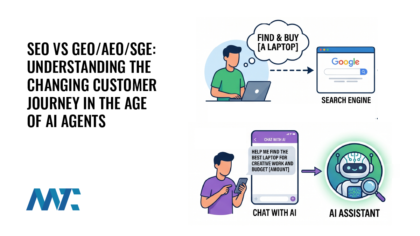
For two decades, the digital customer journey was predictable: a linear progression from a search engine results page (SERP) to a destination website, followed by manual research and an eventual conversion. However, the advent of Generative AI (GenAI) and Large Language Models (LLMs) has introduced a “synthetic” layer into this journey. This shift moves us from traditional Search Engine Optimization (SEO) toward a broader, more complex landscape of Generative Engine Optimization (GEO) and Answer Engine Optimization (AEO).
The Evolution: From SERPs to Generative Answers
In the traditional model, the user acted as their own researcher. They typed a query into Google, scanned blue links, and manually synthesized information from multiple tabs. Today, AI agents—whether LLMs like Gemini or Claude or integrated search features like SGE (Search Generative Experience)—perform this synthesis on behalf of the user.

This delegated research means that the customer journey is no longer about simply winning a click to a homepage; it is about ensuring your brand is the primary data source the AI selects when it constructs its answer. To understand this transition, we must look at how the foundations of SEO have always been the blueprint for the new era of GEO.
The Technical Synergy: Why Great SEO Was Always GEO
There is a common misconception that GEO is a brand-new discipline. In reality, high-level, technical SEO has always encompassed the requirements of GEO. The transition is not a replacement of tactics, but a refocusing on the technical depth that allows machines to parse meaning rather than just keywords.
Brand Consistency and Entity Recognition
At its core, GEO relies on Entity Recognition. An LLM doesn’t just see keywords; it sees entities (People, Places, Things, Brands) and the relationships between them. Great SEO has always reinforced this through Schema Markup (JSON-LD). By providing structured data, you are essentially giving an AI a cheat sheet to understand exactly who you are, what you sell, and how you relate to other concepts in your industry.
Technically, GEO demands absolute Brand Consistency. If your website lists one price, your Google Business Profile (GBP) another, and your LinkedIn page a third, the AI experiences hallucination-inducing friction. It cannot verify the truth of your entity. Technical SEOs who have spent years cleaning up Name, Address, and Phone number (NAP) data across the web were actually performing early-stage GEO without knowing it. The AI requires a singular, unified identity to trust the data it presents to the user.
Contextual Relevance and Semantic Distance
Generative engines look for the shortest semantic distance between a user’s intent and a brand’s solution. Traditional SEO moved away from keyword stuffing toward Latent Semantic Indexing (LSI) and Topic Clusters years ago. These strategies—organizing content by deep topical relevance rather than single keywords—are exactly what AI models use to determine authority. If your site architecture is built on a hub-and-spoke model that covers every nuance of a topic, an AI model is significantly more likely to cite you as a definitive source when it performs its own internal research.
AEO: Capturing the Narrative On and Off the Site
While SEO/GEO focuses on being found, AEO focuses on being the answer. The distinction is critical. In an AEO-driven world, the user may never see your website during the research phase. Instead, they see a synthesized paragraph that cites you. This requires a total shift in how we view our digital presence.
The Digital Presence vs. The Website
Your website is now just one node in a vast network of information that trains an AI model. AEO encompasses information captured across the entire digital ecosystem. To win at AEO, you must optimize your footprint on platforms you do not own:
- Third-Party Reviews & Community Sentiment: AI models heavily weigh Reddit, Quora, and niche forums to gauge real-world sentiment, while Google Business Profile, Yelp, and Trustpilot provide foundational reputation data that informs local and service-based results.
- Earned Media & Press: Mentions and features in major publications, industry journals, and news wires act as high-weight nodes in the AI’s knowledge graph, serving as a critical third-party validator for your brand’s claims.
- Social Proof & Narrative Consistency: Consistent messaging across LinkedIn, X (Twitter), Instagram, and Threads reinforces the model’s confidence in your brand’s identity and current relevance.
- Multimedia Content & Transcripts: High-fidelity information extracted from YouTube videos, vlogs, and Podcasts (via audio transcription) allows AI to capture nuance, tone, and expert commentary that text alone might miss.
- Technical Documents & Deep Research: Data-rich PDFs, whitepapers, case studies, and e-books provide the depth and authority that LLMs use to answer complex, long-tail information queries.
- Listings & Directory Ecosystems: Presence in industry-specific directories, Clutch, BBB, and Yellow Pages establishes a baseline of “entity existence” and verifies geographic and contact legitimacy.
- Marketplaces & Product Data: Granular details from Amazon, Walmart, eBay, and niche e-commerce marketplaces provide the AI with pricing benchmarks, technical specifications, and consumer feedback loops for product-based recommendations.
- Professional & Academic Repositories: Citations in whitepapers, GitHub repositories, and even SlideShare presentations signal a level of technical authority and thought leadership that is highly prioritized for B2B and specialized searches.
The AI’s Confidence Score
Large Language Models function on probability. SEO focused on authority. GEO validates on consistency. When an AI agent conducts dozens of contextually relevant searches on behalf of a user, it is seeking consensus. 1 cheap materials, and your X feed focuses on discounted bulk sales, the AI’s confidence score in your brand identity drops. To rise to the top of an AI’s prioritized list, your branding and messaging must be unfailingly consistent across all platforms. The AI acts as a filter, discarding brands with noisy or contradictory data.
The New Funnel: From Visibility to Priority
In modern search, AI filters results and prioritizes them. This prioritization is the new Rank #1. How does an AI prioritize? It uses a combination of E-E-A-T (Experience, Expertise, Authoritativeness, and Trustworthiness).
For a business to thrive in this journey, it must move beyond Content is King to Data Integrity is King. Every piece of information about your brand—from a podcast transcript to a technical whitepaper—feeds the model. AEO is about ensuring that when the AI goes out to do the dirty work of visiting dozens of sites, it finds a coherent, authoritative story at each site.
Conclusion: The Holistic Digital Footprint
The customer journey has shifted from a manual hunt to a curated recommendation. This doesn’t mean the website is dead; rather, it’s the source of truth that validates the rest of your digital presence.
By mastering the technical foundations of SEO (which feeds GEO) and ensuring a consistent, broad-reaching narrative (which feeds AEO), brands can ensure that when the AI filters the world’s information, your brand is the one left standing at the top of the list. The future of marketing is not about tricking an algorithm; it is about feeding a model with the most consistent, authoritative, and structured data possible. Your digital presence is no longer just a destination—it is a reputation that precedes you in the latent space of artificial intelligence.
Ultimately, the marketer’s mandate has undergone a fundamental expansion: your responsibility is no longer limited to crafting experiences that resonate with a human audience; you must now design for the autonomous agents that serve them. These AI intermediaries act as the new gatekeepers of discovery, scanning the digital horizon for logic, structure, and unwavering consistency before a human ever lays eyes on your brand. To remain relevant, you must treat the AI agent as your primary consumer—providing the high-fidelity, structured data and coherent narrative it requires to confidently advocate for your business.
In this new landscape, winning the customer’s heart starts with earning the machine’s trust.


