Adobe Real-Time CDP: Powering Your Agentic Future with Intelligent Data
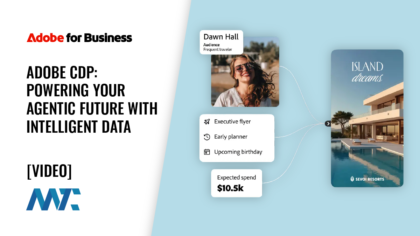
Customer expectations shift in milliseconds, making the challenge for modern marketing and data teams more complex than ever. Siloed information, first-party (1P) vs third-party (3P) data, and the sudden surge in AI-driven interactions have left many organizations struggling to maintain a cohesive view of their customers. When data remains trapped in fragmented systems, the promise of true personalization remains out of reach, leading to missed opportunities and disconnected brand experiences that frustrate both consumers and practitioners.
Adobe Real-Time CDP
Adobe Real-Time CDP is Adobe’s customer data platform (CDP) that unifies and harmonizes data for intelligent activation. Built on the Adobe Experience Platform, it enables organizations to create AI-powered profiles that fuel in-the-moment engagement across the entire customer journey while maintaining strict adherence to privacy and governance standards.

Utilizing this platform allows businesses to transcend traditional batch-and-blast marketing by moving toward a continuous stream of intelligent actions. By centralizing data from data lakes, CRMs, and even unstructured sources such as chat logs and audio in the near future, teams can trigger next-best actions at incredible speed. This unified approach reduces the operational overhead of managing multiple integrations and ensures that every touchpoint—from a website visit to a customer service call—is informed by the same real-time profile. The result is a significant increase in marketing efficiency, improved customer loyalty, and the ability to scale personalization during critical peak business periods without compromising performance.
The Spectrum of Composable and Real-Time Activation
In the evolving debate between composable and packaged architectures, many organizations feel forced to choose between leveraging their existing data warehouse or investing in a dedicated real-time engine. Traditional composable approaches often struggle with the latency required for in-the-moment personalization, while legacy packaged CDPs can create redundant data silos by requiring a complete copy of the enterprise data warehouse.
Adobe Real-Time CDP eliminates this either-or trade-off by operating across the entire spectrum of data management. The platform features a flexible architecture that allows you to federate data directly from your enteprise data warehouse while maintaining the high-speed machinery necessary for millisecond-level activation.

This hybrid approach ensures that your enterprise system of record or warehouse remains the source for long-term analytical workloads, while Adobe handles the in-the-moment engagement. For use cases such as next-page personalization or immediate ad suppression, the platform delivers the speed that warehouse-only solutions cannot match. By offering zero-data copy federation alongside a real-time profile engine, Adobe empowers you to choose the right strategy for each specific use case, ensuring your technology stack is as agile as your marketing strategy.
Whether you are starting with a completely federated, composable approach or require a fully integrated real-time ecosystem, the platform adapts to your technical requirements. It acts as the intelligent bridge between your data center of gravity and the high-velocity touchpoints where your customers live. This flexibility allowed major enterprises like AT&T to evolve from seeking a strictly composable approach to a partnership with Adobe, realizing they needed a foundation that could scale from simple data federation to complex, real-time agentic interactions.
Adobe Real-Time CDP Features
The platform offers a comprehensive suite of tools designed to handle the rigors of modern enterprise data management:
- AI-Powered Audiences: Leverage agentic capabilities to proactively monitor audience size changes and receive natural language explanations for fluctuations.
- B2B and B2C Support: Unify comprehensive data sources to create high-value segments tailored for both individual consumers and complex account-based marketing.
- Data Collaboration: Use a purpose-built environment to securely collaborate with partners, publishers, and agencies without moving or copying underlying datasets.
- Flexible Connectivity: Take full advantage of data warehouse investments through zero-copy data sharing with partners like Snowflake, Google BigQuery, and many others.
- Full Funnel Activation: Discover and engage new audiences without relying on third-party cookies by utilizing trusted second-party (2P) and third-party data partners.
- Mobile and Tablet Accessibility: Manage and monitor your data foundations through dedicated applications that ensure visibility for enterprise teams on the go.
- Real-Time Governance: Apply patented governance policies to ensure that every AI model and customer interaction honors preferences, consent, and global regulations.
- Unstructured Data Integration: Coming soon, harmonize conversational intent, audio, video, and documents alongside traditional CRM data to provide a 3D view of the customer.
By integrating these features, organizations can move from simple audience stitching to sophisticated, multi-faceted customer engagement. This robust toolkit ensures that data is not just collected, but refined into actionable intelligence that drives measurable business outcomes across every digital and physical touchpoint.
Scaling from Orchestrated Journeys to Autonomous Agents
Modern marketing departments often find themselves caught between two worlds: the need for precise, human-led journey orchestration and the rising demand for autonomous, AI-driven experiences. Many legacy systems force a choice between these methodologies, creating a disconnect between the marketing team’s strategy and the actual execution at the customer touchpoint. Adobe Experience Platform bridges this gap by offering a unified layer of shared services that supports a full spectrum of marketer roles, whether you act as a curator of specific paths or an orchestrator of broad outcomes.

Because the platform is built on a single piece of technology with a shared real-time profile, you aren’t required to integrate disparate tools to move from a basic segment to an advanced next-best-action model. You can start by building defined, rule-based journeys where you control every nudge and tangential interaction. As your strategy matures, you can transition to agentic orchestration, where AI agents use the same profile, governance policies, and datasets to make autonomous decisions. This flexibility allows brands to build their own custom user interfaces and AI models while relying on Adobe’s heavy machinery to power the underlying real-time profile and data collaboration.
Whether your goal is to provide a highly productized out-of-the-box application for your marketing team or to build a headless, agent-driven service, the platform provides the necessary extensibility. This ensures that as the industry shifts from campaign-based execution to continuous, intelligent engagement, your organization can adapt without rebuilding its entire data foundation. By balancing pre-built integrations with an open framework, the platform empowers you to pick the bucket you want to work in today while leaving the door open for the agentic future.
Moving Toward an Agentic Future
Real-time is not just about saving money on media suppression; it’s about survival in an agentic era. Estimates suggest that over 50% of customer interactions will occur through agentic touchpoints in the next couple of years. If you can’t keep up with that speed, your CDP becomes an unnecessary piece of middleware.
Ryan Fleisch, Head of Product Marketing for Adobe Real-Time CDP and Audience Manager
Ryan concludes by emphasizing that while current personalization use cases are important, the decision to invest in a CDP today must be viewed as a long-term play for an AI-driven future. To ensure your customer data strategy is resilient enough to handle what he calls the agentic era, he recommends evaluating your decision against these three critical vectors:
- Real-Time Latency: Ensure the platform can handle millisecond-level speeds. As AI agents like chatbots and assistants become the primary interface for over 50% of customer interactions, the system must access a profile, understand context, and deliver a natural-language response instantly.
- Enterprise-Grade Governance: Move beyond manual labeling and human-reliant processes. In an autonomous future, you must have automated machinery that ensures AI agents are honoring customer preferences, consent, and brand-safe governance policies without constant human intervention.
- Unstructured Data Support: Look for a platform that can process more than just basic behaviors and attributes. Since 80% of enterprise data—including conversational intent, audio, and documents—is unstructured, your CDP must be able to harmonize these complex datasets to provide a truly multifaceted view of the customer.
Driving Measurable Impact
According to recent performance metrics, companies utilizing Adobe’s Real-Time CDP ecosystem have seen a 63% uplift in click-through rates through advanced personalization and a 127% increase in annual booked accounts. Furthermore, retargeted email campaigns powered by real-time data have driven a 57% increase in revenue for early adopters.

Getting started with Adobe Real-Time CDP begins by connecting your existing data infrastructure (whether a cloud data warehouse or disparate enterprise systems) via pre-built connectors. Teams can then define their governance policies and identity resolution rules to build a real-time profile for each customer. From there, marketers use natural language prompts and agentic tools to build audiences and orchestrate journeys that react to customer behavior in real time.
Book a demo today to see how Adobe can transform your data into your greatest competitive advantage.


