The Synthesis Era: A Comprehensive Guide to Search Everywhere Optimization in 2026
The digital landscape of 2026 has reached a definitive tipping point. The era of Self-Service Research, where a buyer manually sifts through ten blue links, is being replaced by the Synthesis Era. In this new reality, AI engines and autonomous agents don’t just find information; they accumulate, evaluate, and present it on behalf of the user. We have entered the age of the Zero-Click Buyer, where the website is often the final destination of a transaction rather than the starting point of the research.
As users have become increasingly prompt-savvy, they no longer rely on a single search bar. Instead, they utilize multi-agent platforms that are remarkably adept at evaluating and providing relevant compilations from across the web. While AI results had their early hallucination phases, the present ecosystem is built on sophisticated validation layers. To remain visible, brands must transition from traditional SEO to Search Everywhere Optimization, a paradigm where platforms validate information across multiple channels—social, video, and web—to ensure brand consistency and trust.
The following five key strategies are what I recently presented to our company as we look forward to assisting our customers grow their businesses:
Table of Contents
Technical Excellence: Urgently Fixing Core Web Vitals
To provide a good user experience (UX), Google identifies that sites should strive to have an Interaction to Next Paint (INP) of 200 milliseconds or less. This metric measures a page’s overall responsiveness to user interactions, which is critical for retaining users in high-speed digital environments.
Web.dev
Technical SEO in 2026 is no longer about checking boxes for a bot; it is about eliminating every millisecond of friction that could deter an AI agent or a high-intent human user. As mobile usage has peaked and buyer patience has reached an all-time low, Technical Excellence is now the primary driver of Buyer Velocity.
In the Synthesis Era, AI agents act as the primary interface between the user and your raw data. These agents are programmed to prioritize efficiency. If your site’s architecture is cumbersome, the agent will move to a more accessible competitor. This has led to the rise of Interaction to Next Paint (INP) as the primary conversion signal. While previous metrics focused on how fast a page looked, INP focuses on how fast it feels during use. Every click, toggle, and form field must respond instantaneously. For any modern business, a delay in interaction is a signal of technical debt that AI agents will interpret as a lack of reliability.
Mobile UX in 2026 requires a headless mindset, decoupling the front-end experience from the back-end database to ensure instant loading. Technical infrastructure must now support one-click AI-integrated payments and seamless API handshakes. When an agent visits your site to verify a price or availability, it shouldn’t have to parse through heavy Javascript; it needs clean, server-side rendered data that allows it to complete the user’s request without hesitation.
Local SEO Dominance: Optimizing for the Community Signal
Consumer research shows that 98% of people used the internet to find information about local businesses in the last year, with 87% of consumers using Google Search to evaluate local professional services.
Brightlocal
For businesses with a physical footprint, local SEO is the only way to capture near me intent which, in 2026, is almost entirely filtered through AI agents. However, the definition of local has evolved. It is no longer just about a map pin; it is about the Community Signal, the digital footprint your business leaves across local news, neighborhood forums, and regional directories.
Success in 2026 requires Entity-Matching. AI agents cross-reference your Google Business Profile (GBP) against every other mention of your brand online via citations, including the most prevalent… NAP. If your GBP says you are an expert in consulting, but your local chamber of commerce lists you as a general retailer, the AI agent encounters a trust conflict and may exclude you from the recommendation.
Review sentiment has moved beyond the star rating. AI models now perform deep semantic analysis on the text of your reviews to extract Expertise signals. A high volume of reviews mentioning specific problem-solving capabilities is now more valuable than a high volume of generic five-star ratings. To dominate locally, businesses must foster a neighborhood signal that proves they are an authority within their specific geography, ensuring that when an agent is asked for a recommendation, your business is the statistically safest choice.
Content Infrastructure: Building “Human-First” Depth
Research into Search Engine Results Pages (SERPs) indicates that AI Overviews (AIO) frequently cite high-quality, long-form informational content, with 99.5% of cited pages already ranking in the top 10 positions for the relevant query.
Search Engine Journal
In 2026, the web is flooded with generic GenAI content. Consequently, search engines and users have developed a filter for the fake. To rank and, more importantly, to be cited by AI agents, your content must be undeniably human and highly structured.
Originality is the only remaining currency. If an AI can summarize your blog post without needing your unique data, your content provides no value to the ecosystem. 2026 content must prioritize:
- Unique Data and Insights: Proprietary research, case studies, and first-party data that cannot be found elsewhere.
- Authoritative Authorship: Every piece of content should be tied to a human with a verifiable digital footprint. AI models check the Experience portion of E-E-A-T by looking at an author’s professional history and speaking engagements.
- Original Media: Stock photos and AI-generated imagery are often ignored by sophisticated users and bypassed by AI agents. High-definition, original photography and video are mandatory to prove that your business exists in the physical world.
While humans read the prose, AI agents read the Schema. Every page must be a data-rich environment optimized for extraction. This involves using advanced JSON-LD to tell agents exactly what your data means. We call this Fragment-Based Content—structuring your articles so that an AI can easily clip a specific answer, a pricing table, or a set of FAQs to present in a zero-click interface.
The Zero-Click Evolution: E-E-A-T in an Agent-Mediated World
Recent search data reveals that for every 1,000 searches on Google, 58.5% result in zero clicks to the open web, as Google’s own properties and AI snapshots increasingly answer the user’s query directly.
Sparktoro
The most significant behavioral shift in 2026 is the death of the research click. Buyers are no longer visiting five websites to compare services; they are asking an AI agent to find the best provider with the fastest turnaround time and the most transparent pricing.
This is where the Multi-Agent Ecosystem comes into play. While early AI results suffered from hallucinations, the agents of 2026 are highly sophisticated. They use a consensus-based logic where multiple agents evaluate your brand’s claims against third-party reviews, social media sentiment, and official records. Users have become remarkably prompt-savvy, providing agents with detailed constraints that force the AI to look deeper than surface-level SEO.
In this environment, E-E-A-T (Experience, Expertise, Authoritativeness, and Trustworthiness) is the only barrier to entry. If the agent cannot verify your trustworthiness through secondary sources, you will be excluded from the synthesis. This makes Owned Audiences more critical than ever. Because zero-click results can obscure your brand name, you must move users into direct communication channels like email or SMS. By building a direct relationship, you bypass the AI gatekeeper and ensure your brand remains top-of-mind when the agent presents its final compilation.
Search Everywhere Optimization (SEO + GEO): The Cross-Channel Pivot
Usage of major digital platforms remains high among U.S. adults, with 83% reporting that they use YouTube, making it a critical hub for search and information discovery beyond traditional text-based engines.
Pew Research
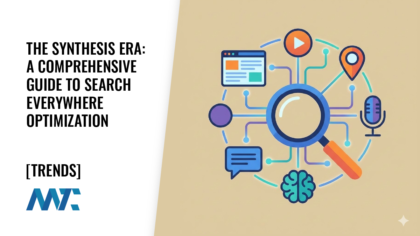
In 2026, Search is a multi-platform behavior. This has birthed the concept of Search Everywhere Optimization (SEO + GEO). This strategy recognizes that modern platforms are now validating information across channels and media. An AI agent doesn’t just look at your website; it checks if your YouTube tutorials match your website’s claims and if your LinkedIn leadership posts align with your brand’s stated values.
The Power of Cross-Channel Validation
To combat the zero-click squeeze, your brand must be ubiquitous and consistent. Search Everywhere Optimization requires:
- Multi-Format Presence: A single topic must exist as a technical article, a short-form video, a detailed podcast segment, and a downloadable data sheet.
- Generative Engine Optimization (GEO): This involves optimizing your presence so that Large Language Models (LLMs) recommend you. This is achieved not through keywords, but through Digital PR—getting mentioned in authoritative listicles, industry news, and community threads (like Reddit).
- Visual Search: With the integration of augmented reality and visual agents, your brand’s physical assets (logos, products, office locations) must be recognizable by visual search engines like Google Lens.
| Strategy Pillar | Traditional SEO (Pre-2024) | Search Everywhere Optimization (2026) |
| Primary Goal | Ranking #1 for Keywords | Being the Consensus Recommendation |
| Success Metric | Click-Through Rate (CTR) | Brand Citation & Agent Validation |
| Content Focus | Keyword Density | Cross-Channel Consistency & E-E-A-T |
| User Journey | Search -> Click -> Browse | Prompt -> AI Synthesis -> Conversion |
The winner of the 2026 search race is not the one who gamed the algorithm, but the one who built the most trusted entity. As AI agents take over the heavy lifting of information gathering, your website must serve as a high-speed, high-trust portal that converts the leads these agents bring to your door. By prioritizing technical velocity, community signals, and human-first depth, you ensure your brand is validated everywhere a search occurs.